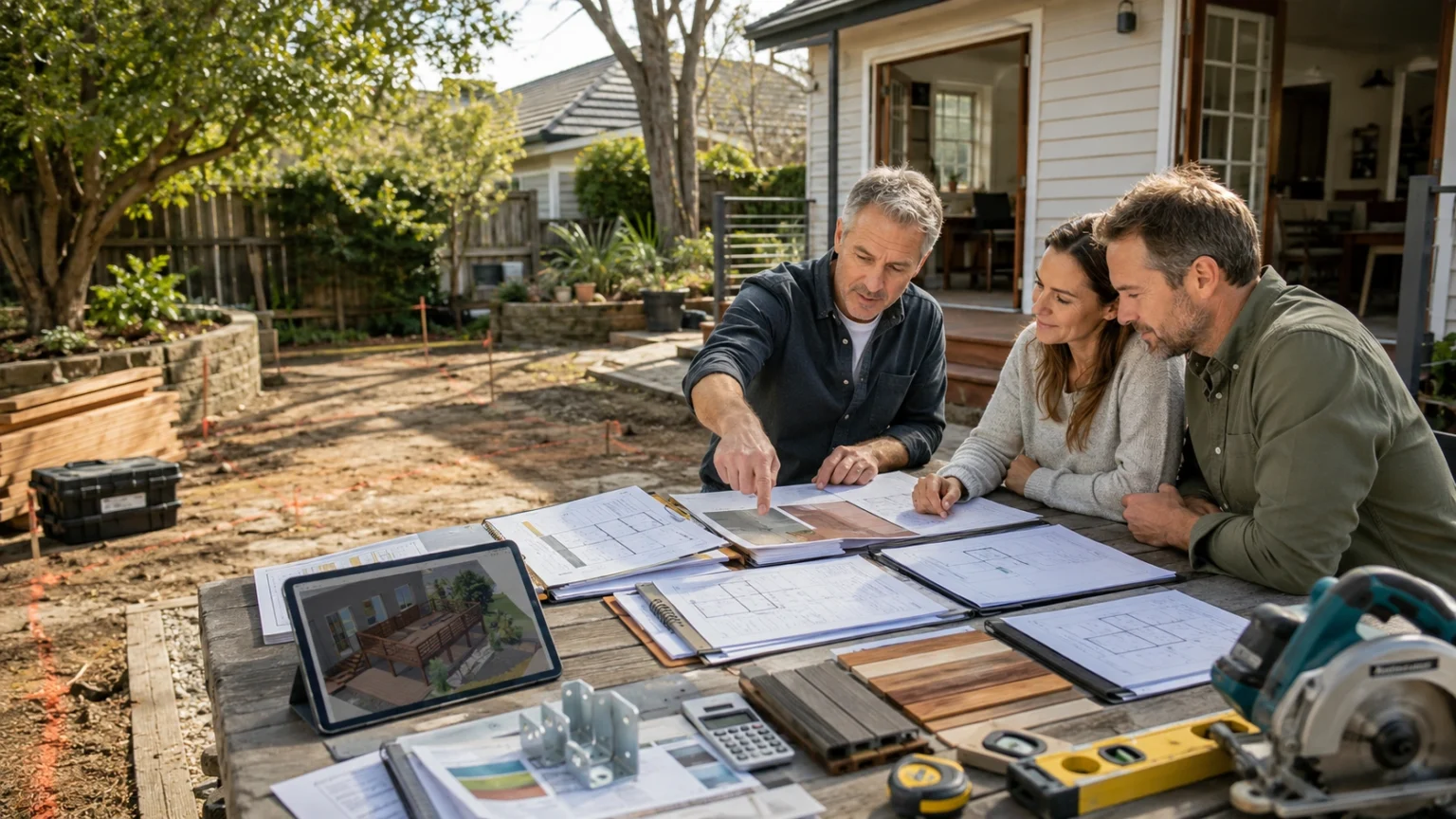
Get clear, comparable deck building quotes in Melbourne. Learn what costs to expect, key questions to ask and spot red flags before choosing.
You're probably at the stage where the idea feels simple. Build a deck out the back, make the yard more usable, get a few quotes, pick one, move ahead.
That's usually when things start to drift.
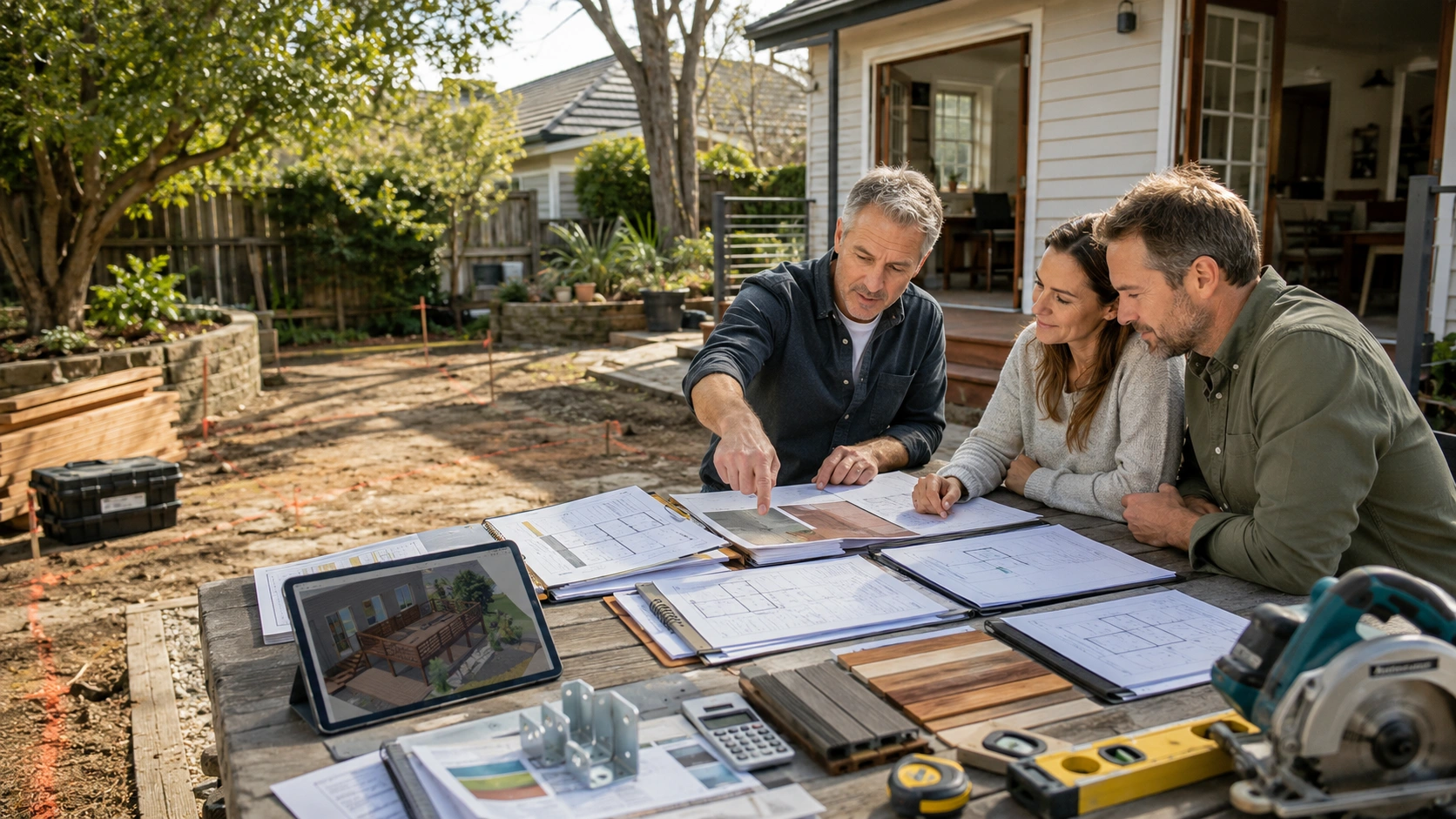
In Melbourne, deck building quotes can vary wildly even when the finished deck sounds identical on paper. One builder is pricing treated pine. Another assumes hardwood. One includes permits, site access issues, rubbish removal and stair details. Another gives you a lump sum and leaves half the scope sitting outside the quote.
A good quote doesn't just tell you what a deck costs. It shows how the builder has understood your site, your design, and the compliance side of the job. That matters in Melbourne suburbs where slope, rear-lane access, narrow side paths, overlays, and permit requirements can change the build before the first post goes into the ground.
How to Prepare for Your Deck Building Quote
The fastest way to get confusing prices is to describe the project vaguely.
If you tell three builders, “I want a deck near the back door, maybe with a step down and some seating later,” you won't get three comparable quotes. You'll get three different assumptions.
For accurate pricing, it's best to provide a fixed scope with drawings and material selections. Relying on sketches or verbal descriptions often leads to incomplete assumptions and unexpected costs later. A preliminary builder chat might take 15 to 30 minutes, but a true quote requires measured plans, as noted in this guidance on getting deck quotes and estimates.
Start with a clear project brief
Write down the basics before you contact anyone.
Include:
- Approximate size: Length, width, and height off the ground.
- Connection to the house: Attached deck, freestanding deck, or landing outside doors.
- Intended use: Dining area, BBQ zone, pool surround, entry platform, or full outdoor living area.
- Material preference: Treated pine, hardwood, or composite.
- Features you already know you want: Stairs, balustrades, built-in benching, privacy screening, lighting cut-outs, or skirting.
- Ground conditions you can see: Sloping yard, retaining walls, drainage grates, trees, service points, or uneven paving.
Photos help more than people realise.
Take wide shots from the house looking out, from the yard looking back, and from each side boundary. If access is tight, photograph the side path and any gates. In many Melbourne suburbs, getting materials to the rear of the property is a real pricing issue, not an afterthought.
Practical rule: If a builder has to guess the scope, you're not getting a real comparison. You're comparing different guesses.
Decide where you can be flexible
Not every decision has to be locked in, but some do.
If you're undecided between timber and composite, say so. If you know you want stairs but haven't settled on the exact width or handrail style, note that too. The point is to separate fixed decisions from open decisions.
That makes follow-up conversations sharper. It also helps you review ideas and inspiration from outdoor renovation examples like these decking and outdoor space projects without losing sight of what your own site can support.
Ask for the same scope from each builder
Send the same brief, photos, and plans to every builder you contact.
If one builder visits and recommends changes, that can be useful. But if those changes alter the scope, ask for the quote to show that clearly. Otherwise you end up comparing one price for a basic platform against another for a more complete build with stairs, permit handling, and upgraded framing.
That's where homeowners often get trapped. The cheapest quote may only be the cheapest version of a smaller job.
Understanding Key Deck Building Cost Drivers
A Melbourne deck quote isn't just about the boards you can see.
Regional pricing is affected by local labour and permit differences, and guidance notes contractor rates can vary by 30% to 50% by region. The same guidance says permits may add about 500 to 2,000 to project cost, while labour and substructure together typically account for roughly 80% of total deck spend. That's why Melbourne quotes should be judged against local conditions, not generic national averages, according to this decking cost overview.

Materials are only one part of the story
Homeowners often focus on the surface boards first. That's understandable because they're visible and they change the look of the deck.
But the bigger budget picture usually sits elsewhere.
- Decking boards: Treated pine, hardwood, and composite all price differently and perform differently over time.
- Substructure timber or framing system: Joists, bearers, posts, fixings, brackets, and footings often drive more cost than people expect.
- Hardware and finishing items: Hidden fasteners, screws, edge trims, fascia, stair nosings, and balustrade components add up quickly.
If you're still deciding on timber species and want a broader read on outdoor timber characteristics, this guide to teak, cedar, and oak furniture woods is useful for understanding how different woods behave outdoors. For decking-specific decisions in local conditions, a more relevant starting point is this guide on the best timber for decking.
Labour shapes the quote more than most people expect
Labour isn't just “install deck”.
It includes set-out, excavation for footings, cutting around irregular house lines, levelling, framing, board installation, stairs, rails, cleanup, and dealing with weather interruptions or restricted access. A flat backyard in a newer estate is one thing. A tight inner or middle-ring Melbourne block with fences, established gardens and no direct rear access is another.
Permits and compliance can change the job
Local knowledge matters.
A low deck with simple dimensions can be straightforward. A raised deck, a deck near boundaries, or a site affected by planning overlays can shift the process. In Victoria, quote accuracy depends heavily on the completeness of the design package and the compliance assumptions behind it, not just the square metres.
A credible Melbourne quote is built around local labour, materials, permits, and site conditions. It isn't pulled from an internet average.
Site conditions can make a modest deck expensive
Two decks with the same footprint can have very different build costs.
Common cost drivers include:
- Access: Narrow paths, no side gate, steps, or long carry distance from street to backyard.
- Slope: More complex footing heights, extra framing, and more labour to level the structure.
- Drainage: Surface water paths, stormwater points, or low spots under the deck.
- Obstacles: Trees, hot water services, gas meters, air-conditioning units, or existing concrete.
A sharp quote separates these cost drivers instead of burying them inside one round number.
How to Decode and Compare Your Quotes
Once the quotes arrive, the worst move is to line up the totals and treat that as the whole decision.
Many homeowners get several prices but don't know how to compare them beyond the final number. A proper estimate should come from an in-person site visit and detail inclusions such as engineering, footing depth, drainage, and access constraints because those items materially change the scope and cost, as outlined in these deck estimate templates and estimating notes.

What a strong quote looks like
A good quote reads like a build plan in plain English.
If you've never looked at a professional estimate before, these examples of professional quote templates help show the level of structure and clarity worth expecting. You don't need the same layout. You do need the same discipline.
Look for these details.
- Site preparation: Existing surface removal, minor demolition, vegetation clearing, levelling, spoil removal, and protection of nearby areas.
- Substructure details: Post type, footing assumptions, framing timber or framing system, joist spacing, and whether the quote assumes standard ground conditions.
- Decking specification: Exact material, board profile, fixing method, finish, and colour if relevant.
- Stairs and balustrades: Number of stairs, width, handrail type, balustrade material, and whether these are included or optional.
- Fixings and hardware: Exterior-rated screws, concealed fixings if applicable, brackets, anchors, and metal connectors.
- Labour scope: Install only, or full project management including set-out, coordination, and completion.
- Rubbish removal: Whether waste, excavation spoil, packaging, and offcuts are taken away.
- Permit management: Whether the builder is pricing permit coordination, engineering input, inspection handling, or leaving it to you.
Vague quote versus detailed quote
This is the comparison that matters most.
Option A
Benefit: A detailed quote gives line items, assumptions, and exclusions.
Limitation: It can look longer and sometimes the total is higher at first glance.
Best use case: Homeowners who want fewer surprises and a cleaner contract stage.
Option B
Benefit: A lump-sum quote looks simple and quick to review.
Limitation: It often hides missing scope, weak assumptions, or later variations.
Best use case: Rarely ideal for anything beyond a very simple, fully defined job.
The phrases that should slow you down
A few common quote habits deserve scrutiny.
- “Deck construction as discussed” usually means the scope isn't properly written down.
- “Standard footings if required” leaves room for argument once excavation starts.
- “Allowance for stairs” is not the same as fully pricing stairs.
- “Permit by owner” may be fine, but only if you know exactly what that responsibility includes.
- “Subject to site conditions” is reasonable in some contexts, but a builder should still explain which conditions remain unknown.
If a quote can't tell you what's included, it can't protect your budget.
How to compare properly
Print the quotes or place them side by side on screen and mark them up.
Check whether each builder has priced the same deck size, the same material, the same stair count, the same rail scope, and the same permit responsibilities. If one quote includes engineering and another excludes it, they are not directly comparable. If one includes demolition and rubbish removal and another doesn't, the cheaper price may disappear quickly.
The best deck building quotes make comparisons easy because they leave less to interpretation.
Essential Questions to Ask Every Builder
A quote tells you how someone prices a job. Your questions tell you how they run one.
This part matters because deck building isn't just carpentry. It's scheduling, communication, supervision, problem-solving, and compliance.

Questions about the business
Start with the basics. Keep it direct.
- Registration and insurance: Ask whether they can provide current details and proof of cover.
- Relevant experience: Ask what kinds of deck projects they build most often, especially on suburban Melbourne sites with access or slope issues.
- Recent references: Ask for recent clients with similar work, not just the best-looking project in the portfolio.
You're not being difficult. You're checking whether the builder works consistently or just presents well in the quoting stage.
Questions about your project
These questions show you how the builder thinks.
- Who manages the site: Ask who your day-to-day contact will be once work starts.
- How they handle design gaps: Ask what happens if plans or selections are incomplete at quote stage.
- Approach to unexpected conditions: Ask how they deal with poor soil, hidden obstructions, drainage issues, or access complications.
- Permit responsibility: Ask who is handling drawings, engineering input, permit applications, and inspections if those are required.
A confident builder won't mind these questions. They should answer clearly, without dodging or overpromising.
Ask the same core questions to each builder. It's the simplest way to compare professionalism, not just price.
Questions about costs and payment
At this stage, plenty of problems start, so get precise.
- Is this a fixed quote or an estimate: Those are not the same thing.
- What is excluded: Ask for exclusions in writing, not just verbal clarifications.
- How are variations handled: You want a clear process before the first change appears.
- What does the payment schedule look like: Payments should match actual progress and clearly defined stages.
Listen to how they answer
The answer matters. The style of the answer matters too.
Good builders tend to be specific. They'll explain what they know, what they need confirmed, and what could change if the scope changes. Poor operators often lean on vague reassurance. “Don't worry about that” is not a process.
If a builder gets irritated by normal due diligence, that's useful information before any contract is signed.
Spotting Red Flags in Deck Building Quotes
Cheap can be expensive.
Outdoor decks have historically been seen as a high-value upgrade, with some estimates putting return on investment in the 65% to 90% range, and one example valuing a $10,000 wood deck at about $8,600 in added resale value, according to this historical discussion of how much a deck could add to your property value. Those figures are U.S.-based, not Australian property data, but the lesson is still useful. A quote that looks too cheap may be cutting into the very quality that gives the deck long-term value.

The quote is far lower than the others
There's usually a reason.
It might exclude stairs, permit handling, demolition, better fixings, proper footing assumptions, or enough labour to do the job cleanly. Sometimes the low number is a tactic to win the job and recover margin through variations later.
The scope is vague
A single-page quote with broad wording is a risk.
If materials aren't properly specified, if the framing isn't described, or if exclusions are missing, you don't have a clear promise of what will be built. You have room for disagreement.
The deposit pressure feels wrong
Be cautious if someone pushes hard for a large upfront payment before details are settled.
Pressure selling has no place in a well-run building project. A builder should give you time to review the quote, ask questions, and understand the contract.
They avoid paperwork
If insurance details, business details, written terms, or variation procedures are strangely absent, stop there.
Good paperwork protects both sides. Builders who resist that usually create trouble once the project is live.
A trustworthy quote makes the builder easier to trust. A murky quote does the opposite.
Communication is slippery from the start
Missed appointments can happen. Repeated vagueness is different.
If emails are unclear, promised revisions never arrive, or basic questions get half-answers, expect more of the same during the build. That's when simple decisions become drawn-out arguments.
From Quote to Contract Your Final Steps
Once you've narrowed the field, don't go back to choosing on price alone.
Lay the quotes beside your notes from each builder conversation. The right choice usually becomes clearer when you weigh four things together: scope clarity, confidence in the builder's process, quality of communication, and how well the quote reflects your actual site.
Choose the builder, not just the number
A solid decision often looks like this:
- The quote is detailed enough to follow
- The inclusions and exclusions are written clearly
- The builder answered questions without dodging them
- The process for changes is straightforward
- The site and permit realities were taken seriously
In Victoria, deck work can cross into permit or approval issues depending on height, site coverage, overlays, and related compliance factors. Before anything is finalised, make sure you understand whether your project needs formal approvals. This overview of council approval for renovations is a useful starting point for homeowners sorting out that side of the job.
Turn acceptance into a proper contract
Accepting a quote shouldn't mean sending a quick text and hoping the paperwork catches up later.
You want a formal written contract that matches the agreed scope, materials, payment stages, and responsibilities. Read it carefully. Check that the quoted inclusions, any exclusions, and any permit responsibilities haven't shifted between the quote and the contract.
If the builder uses digital paperwork, tools that let you electronically sign documents without subscriptions can make the process easier, but convenience isn't the main issue. Accuracy is.
One final check before work starts
Before signing, confirm these points in writing:
- Final plans and specifications
- Material selections
- Who handles permits or approvals if needed
- Payment schedule
- Variation process
- Estimated start timing and build sequence
That final review can save a lot of friction later. The best deck building quotes lead cleanly into a contract because the hard questions have already been answered.
If you're planning a deck or outdoor living upgrade in Melbourne and want practical advice grounded in local building realities, Smarter Home Renovations can help.
Their team handles design, permits, project management, and construction with a strong focus on transparent pricing, durable workmanship, and renovation solutions that suit the way Melbourne homes are built.
Do You Need A Quote
No matter what project you need to complete, our team of professionals at Smarter Home Renovations has the right solution for you.
To find out more about our quality home, kitchen, bathroom and laundry renovations in Melbourne, call Tony on 0418 802 802 today. Or go to our contact page and complete the form its that easy.
Some Handy Links