
Discover the best timber for decking in Melbourne. Compare Merbau, Spotted Gum, and Treated Pine for durability, cost and style.
For Melbourne homeowners, the best timber for decking usually boils down to two heavyweights. There's premium Aussie hardwood like Spotted Gum, loved for its incredible durability and fire resistance. Then you have the ever-popular Merbau, known for its rich colour and stability. Both are brilliant, long-lasting choices, but the right one for you hinges on your budget, how much maintenance you’re prepared for, and the final look you're after.
Your Guide to Selecting the Perfect Decking Timber

A great deck is so much more than a few planks of wood outside your back door; it's a real investment in your home and your lifestyle. It quickly becomes the heart of the home for family get-togethers, quiet morning coffees, and long weekend afternoons in the sun.
But Melbourne’s climate is notoriously tough. The cycle of hot, dry summers and cool, damp winters puts a huge amount of stress on any outdoor building material. Picking the right timber isn't just a style choice, it's critical for creating a deck that’s beautiful, safe, and built to last.
This guide cuts through the noise. We'll walk you through the factors every Melbourne homeowner needs to weigh up, from durability and maintenance to bushfire safety ratings and overall cost. Drawing on over two decades of local experience, our goal is to give you clear, practical advice. We know the options can feel overwhelming, so we’ll break down exactly what you need to know.
Key Factors in Your Decking Decision
Before you start falling in love with a particular type of wood, it’s good to get your priorities straight. The best projects always find that sweet spot between looks, performance, and cost.
Here’s what you should be thinking about for your Melbourne deck:
- Durability and Hardness: How well will it stand up to foot traffic, scraping chairs, and the occasional dropped snag?
- Weather Resistance: Can it handle Melbourne’s sun and rain without twisting, splitting, or rotting away?
- Maintenance Commitment: Honestly, how much time and effort are you willing to put into cleaning and oiling each year?
- Aesthetics and Colour: What kind of look will complement your home's architecture and your own personal style?
- Budget: What’s a realistic price for the materials, not just upfront but considering the lifetime cost of the deck?
Comparing Initial Choices
To get you started, the table below gives a quick overview of the main timber categories we’ll be diving into. Think of it as a snapshot to see how traditional Aussie hardwoods stack up against other common options.
| Decking Category | Typical Lifespan | Maintenance Level | Initial Cost | Main Benefit |
|---|---|---|---|---|
| Australian Hardwoods | 25-40+ years | Moderate | High | Unmatched durability and natural beauty |
| Imported Hardwoods | 20-30+ years | Moderate | Medium-High | Rich colour and excellent stability |
| Treated Softwoods | 15-20 years | High | Low | Most affordable and versatile option |
Getting your head around these fundamentals is the perfect first step. With this foundation, you’re ready to explore our expert insights into building stunning and functional decks and outdoor living spaces in Melbourne that will stand the test of time.
An Overview of Melbourne's The Best Timber For Decking
Choosing the right timber for your deck isn't just a technical decision; it's about defining the personality of your outdoor space. Before we dive into a detailed, head-to-head comparison, let's get acquainted with the leading contenders you'll find across Melbourne backyards.
Each species brings a unique blend of looks, durability, and cost to the table. From premium Australian hardwoods that can handle anything the Melbourne weather throws at them to reliable, budget-friendly choices, this overview will give you a solid feel for what's out there.
Introducing the Hardwood Favourites
Australian hardwoods are legendary for their incredible density and resilience, which is why they’re a top choice for our demanding climate. Spotted Gum is a true local hero, prized for its stunning grain variation and natural fire resistance. Its colours flow from pale grey-browns to deep, rich reds, giving any deck a dynamic and organic feel.
Another heavyweight is Merbau, an imported hardwood famous for its deep, reddish-brown hue and exceptional stability. It’s less prone to warping or twisting than many other timbers, making it a reliable and classic choice for a sophisticated, uniform finish. Then there's Blackbutt, which offers beautiful, lighter blonde and pale brown tones, perfect for creating a modern or coastal-inspired look.
For many homeowners, the choice between native and imported hardwoods really boils down to colour. Spotted Gum gives you a varied, natural palette that feels uniquely Australian, whereas Merbau delivers that consistent, rich red that has defined classic Melbourne decks for decades.
The Reliable and Budget-Conscious Options
Not every project needs the premium price tag of a high-end hardwood. That’s where softwoods and other durable timbers come into their own, offering practical solutions that still perform well.
Treated Pine is, without a doubt, the go-to budget-friendly material. It’s lightweight, easy to work with, and its chemical treatment provides solid protection against rot and termites. While it demands more diligent maintenance to keep it looking sharp, its low upfront cost makes it an accessible starting point for many deck builds.
Another fantastic choice is Cypress Pine. This native softwood has impressive natural resistance to termites and a distinctive yellowish-brown colour with character-filled knots. It sits comfortably between Treated Pine and hardwoods on the price scale, striking a great balance between personality and durability. If you're exploring specific products, you might come across options like Winchester decking timber, which offers particular profiles and dimensions for custom projects.
To help you see how these timbers stack up at a glance, the table below breaks down their key features.
Quick Comparison of Popular Melbourne Decking Timbers
This table gives you a quick snapshot of the key attributes for the most common decking timbers used in Melbourne. It's a great starting point for seeing how they compare on durability, looks, and cost.
| Timber Species | Durability Class (Above Ground) | Janka Hardness Rating (Approx.) | Typical Colour | Estimated Cost (per linear metre) | Primary Benefit |
|---|---|---|---|---|---|
| Spotted Gum | Class 1 | 11.0 kN | Varied Browns & Reds | $$ | High Durability & Fire Resistance |
| Merbau | Class 1 | 8.6 kN | Deep Reddish-Brown | $$ | Excellent Stability & Rich Colour |
| Blackbutt | Class 1 | 9.1 kN | Pale Browns & Blondes | $$ | Modern Look & Fire Resistance |
| Treated Pine | H3 Treated | 5.5 kN | Light Yellow/Green | $ | Most Affordable & Versatile |
| Cypress Pine | Class 1 | 6.1 kN | Yellowish-Brown | $ | Natural Termite Resistance |
While this gives you the basic stats, remember that the "best" timber really depends on your specific site, budget, and the look you're trying to achieve. We'll explore these nuances in more detail in the sections to come.
Comparing Hardwood Decking Options for Durability and Style
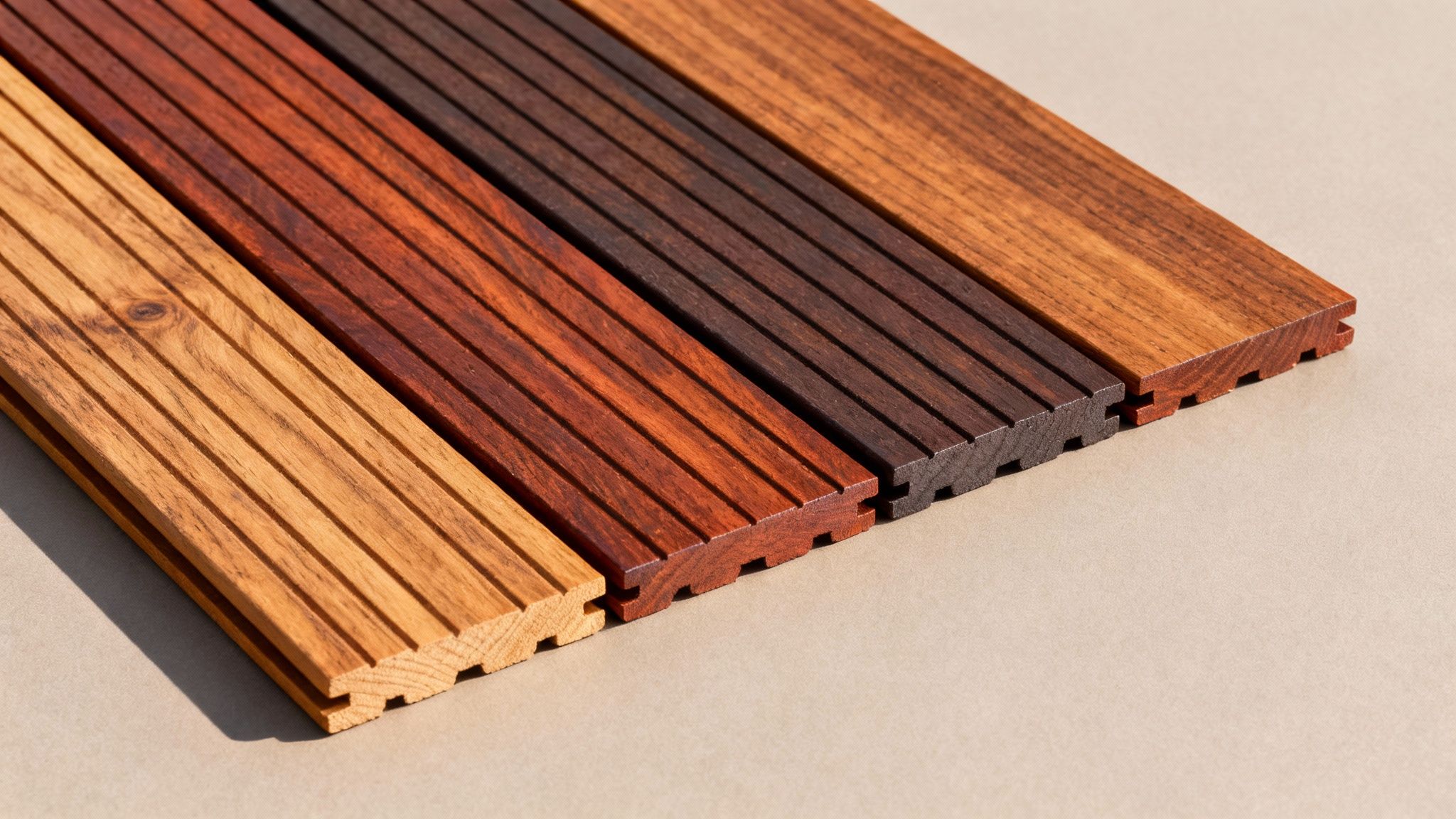
Alright, let's get into the nitty-gritty of choosing the right hardwood for your Melbourne deck. It's time to weigh up the top contenders: Spotted Gum, Merbau, Blackbutt, and Jarrah. Choosing the best timber goes way beyond a simple list of pros and cons; it’s about matching the unique character of the wood to your home, your lifestyle, and the Melbourne climate.
This is where experience counts. The 'best' timber isn't just a technical specification, it's the one that feels right for your specific situation.
The Durability Champion: Spotted Gum
There's a good reason Spotted Gum is considered one of Australia’s top-tier decking timbers. With an incredibly high density and a Janka hardness rating of around 11.0 kN, it’s built to handle whatever you throw at it.
Imagine a deck that’s the heart of your home's social life, constant family barbecues, chairs scraping, kids and pets running wild. Spotted Gum’s tough nature means it resists scratches and dents like a champion, keeping its good looks for years.
Better still, its natural fire resistance (up to BAL 29) is a non-negotiable for homes in Bushfire Prone Areas. This isn't just about ticking a box for compliance; it's genuine peace of mind. Its beautiful grain and colour variations, from pale browns to rich chocolates, also mean that every Spotted Gum deck is one-of-a-kind.
Situational Recommendation for Spotted Gum:
Perfect for high-traffic family decks, homes in bushfire zones, or anyone after a premium, uniquely Australian aesthetic with maximum durability. The higher upfront cost is absolutely justified by its sheer longevity.
The Timeless Classic: Merbau
For years, Merbau has been the reliable workhorse for Melbourne decks, loved for its exceptional stability and deep, consistent colour. Its rich, reddish-brown tones lend a classic, almost luxurious feel that works beautifully with both traditional and modern homes.
One of Merbau's biggest selling points is its low shrinkage and expansion rate. In a city like Melbourne, where the weather can change in an instant, this stability means less risk of your boards warping or cupping over time.
The one thing to watch for is "tannin bleed." When new, Merbau can leach natural oils, which might stain any light-coloured pavers or concrete underneath. It’s easily managed by pre-washing the boards or sealing them promptly, but it’s something you need to plan for. Knowing how to handle these material quirks is key to a great result when it comes to decking to transform your outdoor space.
The Modern Favourite: Blackbutt
If you’re chasing a bright, contemporary, or coastal vibe, you can’t go past Blackbutt. Its beautiful blonde and pale brown tones create a light, airy feel, making any outdoor space feel bigger and more inviting.
Like Spotted Gum, Blackbutt is a homegrown Aussie hardwood with top-tier durability (Class 1) and excellent natural fire resistance. This makes it a tough, safe option that delivers clean, modern style.
The main catch with Blackbutt is that it can be prone to surface checking (fine cracks) if it's not sealed correctly. It needs a diligent application of a high-quality, UV-protective oil to maintain its stunning colour and prevent cracking. For homeowners who are on top of their maintenance, the visual payoff is enormous. A detailed comparison of Blackbutt and Spotted Gum decking is well worth a read if you're weighing up these two Aussie favourites.
In Australia, spotted gum stands out as one of the premier timbers for decking, prized for its incredible durability and natural resistance to the harsh outdoor conditions prevalent across Melbourne and beyond. Statistical data from Australian timber wholesalers highlights its popularity: in 2025, the timber wholesaling industry, valued at $5.9 billion nationally, saw hardwoods like spotted gum driving a significant portion of decking sales.
For Melbourne homeowners, this timber's termite resistance, classified as 'resistant' under AS 3660.1 standards, can cut maintenance costs significantly compared to untreated alternatives. With Australia's wooden decking market growing, choosing a high-performance timber ensures a timeless, low-maintenance deck.
The Rich and Rustic: Jarrah
Hailing from Western Australia, Jarrah is famous for its stunning deep red and burgundy colours. It adds instant warmth and character, making it a brilliant match for heritage homes or garden designs aiming for a classic, rustic feel. If left unoiled, it will age gracefully into a beautiful silvery-grey.
With a high density and Class 2 durability rating, Jarrah is naturally resistant to rot and termites, giving it a long lifespan. While it’s a very hard-wearing surface, it's not quite on the same level of toughness as Spotted Gum.
Ultimately, choosing Jarrah often comes down to falling in love with its unique colour. If that rich, deep red is central to your design vision, Jarrah delivers beauty and strength in equal measure.
Head-to-Head Hardwood Comparison
To make the choice a little easier, here’s a quick breakdown based on different project needs.
| Feature / Scenario | Spotted Gum | Merbau | Blackbutt | Jarrah |
|---|---|---|---|---|
| Best for High Traffic | Excellent | Good | Very Good | Good |
| Best for Fire Prone Areas | Excellent (BAL 29) | Good (BAL 19) | Excellent (BAL 29) | Good (BAL 19) |
| Modern Aesthetic | Very Good | Good | Excellent | Fair |
| Classic/Heritage Look | Good | Excellent | Fair | Excellent |
| Colour Consistency | Low (High variation) | High | Medium | Medium |
| Maintenance Sensitivity | Low | Medium (Tannin bleed) | High (Sealing) | Medium |
Choosing the right hardwood is a balance between durability, looks, and how much maintenance you’re prepared to do. By thinking about these real-world scenarios, you can pick a timber that won't just look good on day one, but will be a perfect fit for your home for many years to come.
Considering Softwoods and Composite Decking

While premium hardwoods deliver incredible durability and that classic, high-end look, they aren't the only way to create a fantastic outdoor space. For many Melbourne homeowners, the best timber for a deck is the one that nails the balance between budget, maintenance, and style. This is where practical alternatives like softwoods and modern composites really come into their own.
These options cater to completely different priorities. Some are about getting a stunning deck on a tighter budget, while others are for creating an outdoor area that needs almost no annual upkeep. Let's do a proper cost-benefit analysis to see if a budget-friendly or low-maintenance solution is the right fit for your project.
The Budget-Friendly Workhorse: Treated Pine
Treated Pine is, without a doubt, the most affordable decking material you can get your hands on. This makes it a go-to choice for first-home builders, investment properties, or massive decks where the bottom line is a major factor. Its versatility is a huge plus; it’s lightweight, easy to work with, and takes stains and paints beautifully, giving you total creative freedom over the final look.
But that affordability comes with a trade-off in longevity and elbow grease. Treated Pine is much softer than hardwoods (with a Janka rating of around 5.5 kN), so it’s more likely to get dented and scratched. To stop it from greying, warping, or splitting under Melbourne's harsh sun and soaking rain, it needs a strict maintenance schedule of cleaning and resealing, often every single year.
A well-maintained Treated Pine deck can last 15-20 years, but how good it looks is directly tied to your commitment to upkeep. It’s a brilliant choice if your main priority is low initial cost and you don’t mind the ongoing maintenance.
The Character-Filled Mid-Range Option: Cypress Pine
Cypress Pine hits a sweet spot right between the affordability of Treated Pine and the premium feel of hardwoods. This native Australian softwood has a secret weapon: its natural oils and resins make it inherently resistant to termites and rot, earning it a top-tier Durability Class 1 rating.
Visually, Cypress has a unique charm. It has warm, yellowish-brown tones and plenty of knots, which creates a more rustic, character-filled look. It’s also harder than Treated Pine, so it stands up better to everyday wear and tear. While it still needs sealing to protect its colour, its natural toughness takes some of the maintenance pressure off.
Consider Cypress Pine if you're looking for:
- Natural termite resistance without any chemical treatments.
- A unique, rustic aesthetic that stands out from the crowd.
- A durable option that’s more budget-friendly than premium hardwoods.
The Rise of Low-Maintenance Composite Decking
In the last few years, composite decking has become a massive contender, offering a lifeline for homeowners who love the idea of a deck but hate the annual chore of sanding and oiling. Made from a blend of recycled wood fibres and plastics, high-quality composite boards are engineered to resist fading, staining, scratching, and mould.
The number one benefit is the minimal upkeep. A simple wash-down with soap and water is usually all it takes to keep it looking sharp. The colour is consistent right through the board and is UV-stabilised, which means the deck you install is the one you'll have for years, with no fading or greying.
Of course, these perks come at a higher initial cost, often on par with or even more than premium hardwoods. It's also worth noting that darker composite colours can get pretty hot underfoot in direct summer sun, a key point for any Melbourne backyard. For anyone weighing up their options, checking out a detailed breakdown of composite vs timber decking can offer deeper insights into the long-term value.
Ultimately, Your Choice Comes Down To Priorities
If the initial budget is the main driver, Treated Pine is a solid, versatile choice. If you love natural timber character but with less worry, Cypress is a strong contender. But if your goal is a hassle-free outdoor living space for the long haul, the upfront investment in composite decking can pay for itself many times over in saved time and maintenance.
Choosing the right timber is a massive step, but those beautiful hardwood boards are only half the story. A Melbourne deck that truly lasts depends just as much on what’s happening underneath and the care it gets over the years. Think of it as a complete system, every part needs to work together to fight off our wild weather and stand the test of time.
Ignoring these fundamentals is like building a beautiful house on shaky ground. It just won’t last. From the hidden sub-frame to the final coat of oil, these are the details that separate a deck that thrives from one that fails before its time.
The Unseen Hero: Your Deck Sub-Frame
The sub-frame is the skeleton holding everything up. You can have the most durable, expensive hardwood in the world, but if the foundation is weak, poorly built, or rotting away, the whole deck will fail. In Melbourne's damp winters, a cheap or untreated sub-frame is basically an open invitation for moisture damage and termites.
This is exactly why we build our sub-frames with H3 and H4 treated pine. This timber is specifically rated to resist decay and termites, making sure the core of your deck stays solid for decades. It’s a small extra investment that pays off enormously in longevity and peace of mind.
A deck is only as strong as its sub-frame. Putting premium decking boards on a cheap, untreated frame is a recipe for disaster. The foundation has to be built to outlast the surface it supports.
Giving Your Deck Room to Breathe
Ventilation is one of the most critical parts of deck construction, but it’s amazing how often it gets overlooked. Trapped moisture is timber’s worst enemy. It creates the perfect breeding ground for mould, mildew, and wood rot, especially on the low-level decks so common in Melbourne backyards.
To guarantee proper airflow, we stick to a few non-negotiable design principles:
- Minimum Ground Clearance: We always ensure there’s a gap of at least 300mm between the ground and the bottom of the joists. This space is vital for air to circulate freely and dry out any moisture that gathers underneath.
- Adequate Board Spacing: A consistent gap of 4-6mm between each decking board is key. It lets water drain away easily and, just as importantly, helps ventilate the sub-frame from above.
- Clear Edges: We make sure the edges of the deck are kept clear of garden beds or other obstructions that can block airflow and trap damp air.
These small details make a huge difference, preventing the kind of slow, hidden decay that can completely ruin a deck from the inside out.
Finishing and Ongoing Maintenance
Your choice of finish is the final shield against Melbourne's harsh UV rays and relentless rain. A high-quality decking oil does more than just bring out the timber’s natural colour, it soaks into the wood to repel water and stop the sun damage that leads to that familiar grey, splintered look.
A simple maintenance schedule will preserve both the beauty and the structural integrity of your timber for years to come.
Recommended Maintenance Schedule:
- Initial Sealing: Every new deck needs to be properly cleaned and sealed within a few weeks of installation to protect the fresh timber.
- Annual Inspection: At the start of spring, give your deck a good clean and a once-over, checking for any signs of wear and tear.
- Re-oiling: For most hardwoods in Melbourne, re-oiling every 12-18 months is about right. If your deck is in full, direct sun all day, you might need to do it every 6-12 months to stop it from fading.
Understanding Local Regulations
Finally, a deck that lasts is one that’s built to code. In Victoria, you’ll often need a building permit, especially for decks over a certain size or height.
Even more importantly, if your home is in a Bushfire Prone Area, your timber choice has to meet a specific Bushfire Attack Level (BAL) rating. Timbers like Spotted Gum and Blackbutt are fantastic choices here, as their naturally high BAL ratings ensure your deck isn’t just beautiful, but fully compliant and safe.
So, Which Decking Timber Should You Choose?
Alright, we’ve unpacked the details on Melbourne’s most popular decking timbers. Now comes the important part: translating all that information into the right choice for your home, your budget, and your lifestyle. It's about confidently matching the perfect timber to your specific situation.
To make it easier, let's walk through a few common scenarios we see across Melbourne. This should help you pinpoint which timber is the natural fit for what you're trying to achieve.
Matching Your Decking to Your Lifestyle
Every household is different, and what works for one person might not work for another. The "best" timber is simply the one that aligns with your priorities.
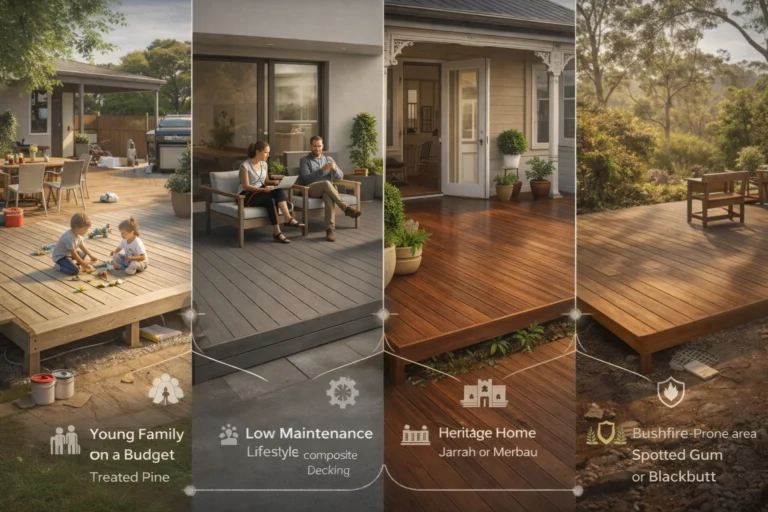
For a Young Family on a Budget: It's hard to go past Treated Pine. Its low initial cost means you can get a functional outdoor space up and running without blowing the budget, freeing up cash for other things. Plus, you can stain it any colour you like. It does need a bit of love each year, but its affordability makes it a fantastic way to create a great space for the kids.
For the Ultimate Low-Maintenance Deck: If you'd rather spend your weekends enjoying your deck than working on it, then a high-quality composite decking is the clear winner. Yes, the upfront investment is higher, but it pays you back over the years with next to no upkeep. It’s the ideal set-and-forget solution for busy professionals or anyone who wants a deck that looks perfect all year round without the hassle.
For a Heritage Home: To do justice to a classic Melbourne property, you need timber with character. Both Jarrah and Merbau are brilliant choices here. Jarrah’s deep, luxurious reds and Merbau’s rich, consistent colour bring a timeless elegance that respects traditional architecture, creating a beautiful flow from indoors to out.
For a Bushfire Prone Area: When safety is the top priority, the choice is clear: Spotted Gum or Blackbutt. Their high BAL ratings are non-negotiable for meeting strict building codes in these areas, giving you crucial protection and peace of mind. Spotted Gum’s legendary durability also makes it a premium, long-lasting option for any high-end project.
Choosing a deck isn't just a building decision; it's a lifestyle one. Be realistic about the time you can commit to maintenance, it’s often the single most important factor in long-term satisfaction.
Making Your Deck Last
This decision tree gives you a great visual on how those early choices play a huge role in how long your deck will last.
As you can see, things like a solid sub-frame and proper ventilation are just as important as the timber you lay on top.
Why a Professional Installer is Worth Their Weight in Gold
Finally, always remember that even the best timber in the world can fail if it’s installed poorly. A professional installer is your guarantee that every crucial detail, from the sub-frame and ventilation to board spacing and fixings, is handled correctly from the get-go.
When you're looking for a contractor, ask to see a portfolio of their local work, make sure their quotes are transparent, and check that they have a deep understanding of Melbourne’s building codes. That expertise is the best insurance you can get for a beautiful, safe, and durable deck you’ll be enjoying for decades to come.
Your Top Decking Questions Answered
We get asked a lot of questions about choosing the right timber for Melbourne decks. Here are the answers to some of the most common queries we hear from homeowners.
How Often Should I Maintain My Timber Deck in Melbourne?
For most hardwood decks, the Melbourne climate means you'll want to re-oil them every 12 to 18 months. This is crucial for protecting the timber from UV damage and moisture. If your deck gets a lot of direct sun, you might need to do it more often, perhaps every 6 to 12 months.
Treated pine is a bit needier and often requires more regular sealing to stop it from going grey and starting to split. A good rule of thumb is to give your deck a proper clean each season and just keep an eye on how it’s holding up to decide on the best schedule.
Do I Need a Council Permit to Build a Deck in Melbourne?
This really depends on the deck’s size, where you're putting it, and how high off the ground it is. Generally, in Victoria, you’ll need a building permit if the deck is more than 800mm above ground level, is attached directly to your house, or is larger than 10 square metres.
Keep in mind that regulations can differ slightly from one council to the next. It’s always best to check with your local authority before you start any construction work to make sure everything is above board.
Why Is a Fire-Resistant Timber like Spotted Gum a Good Idea?
If your home is in a Bushfire Prone Area (BPA), choosing a fire-resistant timber isn't just a good idea, it's often a requirement under Australian building standards (AS 3959). Timbers like Spotted Gum, Blackbutt, and Merbau have high BAL ratings, which improve your home’s safety and ensure you’re compliant.
Even if you’re not in a BPA, their natural density offers fantastic durability and that extra peace of mind.
Ready to build the deck of your dreams with timber that’s perfect for Melbourne's climate? The team at Smarter Home Renovations has the local expertise to guide you through every step.
Contact us today for a consultation and start planning your perfect outdoor space.