Know the Renovation Cost in Melbourne. Get a clear price breakdown for kitchens, bathrooms, extensions and budgeting tips to plan your project
So, you’re thinking about renovating in Melbourne? It's an exciting time, but the first question on everyone's mind is always: "How much is this going to cost?"
The short answer is that renovation costs in Melbourne can range anywhere from A$800 per square metre for a simple cosmetic touch-up to well over A$4,500 per square metre for a high-end, bespoke transformation. Think of this as a starting point. The final number will really depend on how big your plans are, the quality of materials you choose, and the complexity of the work involved.

Your Quick Guide to Melbourne Renovation Costs
Jumping into a home renovation is a huge step, but figuring out the budget from the get-go is the most important part of the puzzle. It’s a bit like buying a car. You’ve got your standard model, a mid-range option with a few extra bells and whistles, and the luxury version with all the premium finishes. The final price tag comes down to what you decide you want and need.
In the same way, there’s no single, fixed price for a renovation in Melbourne. It’s a flexible range that moulds to your vision. A simple refresh with a new coat of paint and some modern flooring will sit at the lower end of the cost spectrum. On the other hand, a full structural overhaul with custom-made joinery and high-end finishes will naturally be at the top end.
The Three Tiers of Renovation Budgets
To make things a bit clearer, let's break down renovation costs into three general tiers. This is how the industry often categorises projects, and it gives you a practical framework for figuring out where your ideas might fit.
- Basic Renovations: This is your entry-level, cosmetic-focused tier. It’s perfect for giving a space a quick lift without touching the layout. We're talking about things like painting, laying new floors, and swapping out minor fixtures like light fittings or taps.
- Mid-Range Renovations: This is the sweet spot for most Melbourne homeowners. It involves more significant work, like changing room layouts, putting in a brand-new kitchen with new cabinetry and benchtops, or completely gutting and redoing a bathroom with good-quality, reliable products.
- High-End Renovations: This is the top tier, reserved for projects that call for premium materials, custom craftsmanship, and luxury finishes. Think natural stone benchtops, architecturally designed spaces, bespoke joinery, and major structural changes to the home.
A really helpful way to create an initial budget is to use a per-square-metre estimate. It’s a standard metric in the building industry that helps you establish a realistic starting point based on the size of your space and the level of finish you’re after.
To put some numbers to it, a basic cosmetic update is a cost-effective way to modernise your home. A mid-range project hits that perfect balance of quality and value, allowing for some serious improvements. A high-end reno, of course, delivers a completely customised result, reflecting a major investment in both top-shelf materials and expert labour.
Based on current industry data, a simple cosmetic project could start around A$800 to A$1,200 per square metre. For more involved, mid-range projects, you're likely looking at A$1,500 to A$2,500 per square metre. For premium, high-end renovations, costs can easily push past A$3,000 to A$4,500 per square metre.
If you'd like to dive deeper into the specifics, you can learn more about what to expect for home renovation costs in Melbourne.
To make this easier to visualise, here’s a quick summary of what you might expect to pay per square metre for different levels of renovation work in Melbourne.
Estimated Renovation Costs in Melbourne Per Square Metre
| Renovation Tier | Typical Inclusions | Estimated Cost per m² (AUD) |
|---|---|---|
| Basic (Cosmetic) | Painting, new flooring, updated light fittings & tapware, minor repairs. No layout changes. | A$800 – A$1,200 |
| Mid-Range (Standard) | New kitchen or bathroom, layout alterations, new windows, quality fixtures & appliances. | A$1,500 – A$2,500 |
| High-End (Premium) | Structural changes, architectural design, custom joinery, luxury materials (e.g., natural stone), premium appliances. | A$3,000 – A$4,500+ |
This table should give you a solid ballpark figure to start your planning. Remember, these are estimates, and the best way to get an accurate cost is to speak with a professional builder who can assess your specific project.
Breaking Down Costs by Renovation Project
Alright, we've looked at the broad per-square-metre figures, but now it's time to get into the specifics. While general estimates are a good starting point, the real planning begins when you zoom in on individual rooms. It goes without saying that the cost of a renovation in Melbourne changes dramatically depending on whether you're tackling a kitchen, a bathroom, or a full-blown home extension.
Think of it like packing for a trip. A quick weekend away just needs a small bag with the basics. A two-week overseas adventure? That requires a massive suitcase with all sorts of gear. It's the same with renovations, a bathroom reno is compact but intensive, packed with pricey waterproofing and plumbing. A kitchen, on the other hand, demands a bigger budget for appliances, cabinetry, and benchtops.
Getting a handle on where your money is actually going in each of these key areas is the first step to building a budget that won't fall apart. It helps you move from abstract numbers to a solid financial plan for your project.
The Heart of the Home: The Kitchen Renovation
The kitchen is almost always the most complex and expensive room to renovate per square metre. It's the hub of the home, a high-traffic zone where plumbing, electrical work, detailed joinery, and tough surfaces all have to come together perfectly. It’s a serious investment.
The final price tag really comes down to three things: cabinetry, benchtops, and appliances. A budget-friendly kitchen might use flat-pack cabinets and laminate benchtops. A mid-range project usually steps up to semi-custom cabinetry and engineered stone, while a high-end renovation will feature completely bespoke joinery, natural stone surfaces, and premium, integrated appliances.
- Budget Kitchen Renovation: Expect to spend between $20,000 and $35,000. This typically gets you laminate benchtops, flat-pack cabinetry, and standard appliances. To keep costs down, you'll almost always stick to the existing layout.
- Mid-Range Kitchen Renovation: This tier usually lands between $35,000 and $60,000. It opens the door to better materials like engineered stone benchtops, semi-custom cabinets, and higher-quality appliances. You might even have room for minor layout tweaks.
- High-End Kitchen Renovation: A premium kitchen renovation in Melbourne starts from $60,000 and can easily sail past $100,000. This involves custom-built joinery, natural stone or high-end porcelain benchtops, architectural design, and top-of-the-line appliances.
For a more granular look at where your funds will be allocated, you can explore our detailed guide on the kitchen renovation cost in Melbourne.
The Essential Retreat: The Bathroom Renovation
Don't let its small size fool you, a bathroom renovation is incredibly labour-intensive. A huge chunk of the budget, often around 70%, goes straight to the tradies: licensed plumbers, electricians, tilers, and waterproofers. This is one place you absolutely cannot afford to cut corners, as a waterproofing failure can lead to catastrophic (and expensive) damage.
The other 30% of your budget is for all the things you can see and touch, the fixtures and finishes. Your choice of tiles, vanity, tapware, and shower screen will make a big difference to the final figure. The most cost-effective path is usually a stylish makeover that keeps the original layout intact.
A key takeaway for bathroom budgeting is that moving plumbing is a major cost driver. If you can work with the existing layout of your toilet, shower, and vanity, you can save thousands of dollars in plumbing labour.
A basic refresh might cost around $15,000, focusing on new tiles, a pre-fabricated vanity, and fresh tapware. A full mid-range renovation that includes layout changes and better-quality fixtures typically sits between $25,000 and $40,000. For a luxury bathroom with all the trimmings, like underfloor heating, a freestanding bath, and custom features, costs can soar above $50,000.
To help you visualise these costs, we've put together a simple table that breaks down the average price ranges for common renovation projects across Melbourne.
Average Cost for Common Melbourne Renovation Projects
This table gives you a snapshot of estimated costs for different projects, whether you're looking at a single room upgrade or a larger-scale job.
| Project Type | Budget Range (AUD) | Mid-Range (AUD) | High-End (AUD) |
|---|---|---|---|
| Basic Bathroom Update | $15,000 - $25,000 | $25,000 - $40,000 | $40,000+ |
| Standard Kitchen Reno | $20,000 - $35,000 | $35,000 - $60,000 | $60,000+ |
| Laundry Room | $8,000 - $15,000 | $15,000 - $25,000 | $25,000+ |
| Full Home Extension (per m²) | $2,500 - $3,500 | $3,500 - $5,000 | $5,000+ |
These figures are a great starting point for your budget, but remember that the final cost will always depend on the specifics of your home and your personal choices.
Expanding Your Horizons: The Home Extension
Adding more square metres to your home is the most expensive type of renovation, but it's also the one that adds the most value. The cost is driven by major work like foundations, structural engineering, roofing, and external cladding, all before you even start thinking about the internal fit-out.
Interestingly, the cost per square metre for an extension is often higher than for a new build. That's because builders have to seamlessly stitch the new structure onto the old one, which can throw up some unique and tricky challenges.
This chart gives you a clear visual on how the costs stack up for different tiers of Melbourne renovations.
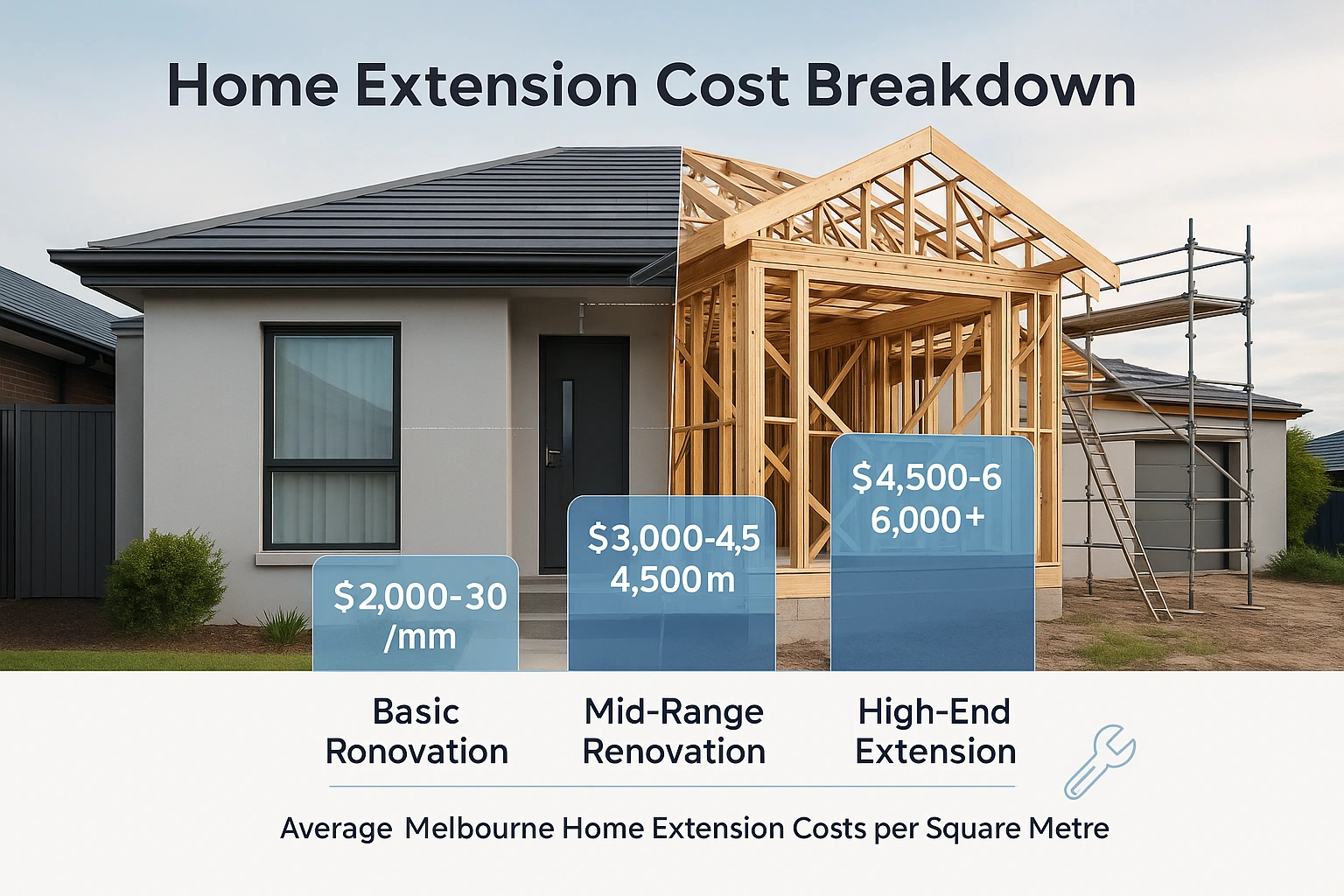
As you can see, while a basic refresh is within reach for many, a high-end project is a substantial financial undertaking, often costing nearly four times as much per square metre.
Victorian homeowners have a real passion for improving their properties. In fact, a recent report on home renovation statistics found that in 2025, homeowners in Victoria spent an average of A$74,800 per renovation. Typical spending in Melbourne breaks down to $27,500 for kitchens and $19,000 for bathrooms, while major home extensions can cost well over A$145,000. It just goes to show the significant investment Melburnians are willing to make in their homes.
Understanding Your Biggest Cost Drivers
Ever looked at a renovation quote and wondered why one kitchen comes in at $20,000 while a seemingly similar one soars past $80,000? It's rarely one single thing. Instead, the final cost of a Melbourne renovation is a cocktail of different choices and circumstances that can either keep your budget grounded or send it into the stratosphere. Getting a handle on these key drivers is the first step to making smart, cost-effective decisions.
Think of it like choosing a car. Your project's scope is the engine. A simple cosmetic refresh, a lick of paint, some new tapware, is like a small, efficient four-cylinder engine that's light on fuel. But the moment you decide to knock down a wall, you've just upgraded to a high-performance V8. It demands more power, more resources, and a much bigger budget to run.
Structural Changes and Their Domino Effect
By far, the single biggest cost driver in any renovation is changing the structure. We’re talking about moving walls, shifting windows and doors, or altering your plumbing and electrical layout. These changes aren't just expensive on their own; they set off a powerful domino effect that ripples through your entire budget.
For instance, taking out a load-bearing wall is so much more than just demolition. Suddenly, you need:
- An Engineer: To run the numbers and calculate the new structural loads.
- A New Beam: To take the weight that wall was holding up.
- Extra Labour: To install the beam and then make good the surrounding ceiling, walls, and floors.
- Council Permits: Because it's a major structural alteration.
What started as a simple idea to "open up the space" quickly spirals into a complex, multi-trade job that can add thousands to the final bill. The same logic applies to wet areas. Keeping your toilet, shower, and vanity in their original spots is one of the smartest ways to keep a lid on costs. You can learn more by exploring our detailed guide to bathroom renovation costs in Melbourne.
Materials and Finishes: From Standard to Luxe
Your choice of materials and finishes is the next major player in your budget. This is where the difference between buying a suit off-the-rack versus getting one custom-tailored really comes into focus. You can achieve a very similar look with wildly different price tags.
Let's look at how the costs can stack up for a few common choices:
| Feature | Budget-Friendly Option | Mid-Range Option | High-End Option |
|---|---|---|---|
| Kitchen Benchtops | Laminate (~$200/m²) | Engineered Stone (~$800/m²) | Natural Marble (~$1,500+/m²) |
| Flooring | Vinyl or Laminate | Engineered Timber | Solid Hardwood |
| Cabinetry | Flat-pack (Melamine) | Semi-custom (2-pac) | Fully Custom Joinery |
Each step up in quality doesn't just increase the material cost; it often demands more skilled (and therefore more expensive) labour to get the installation right.
A savvy renovator knows where to save and where to splurge. It pays to invest in high-touch, high-impact items like benchtops and tapware, but you can pull back on things like laundry cabinetry or wardrobe interiors.
The Hidden Costs Lurking Behind the Walls
The most frustrating costs are always the ones you never saw coming. Older Melbourne homes, especially those built before the 1990s, are notorious for hiding expensive surprises behind their walls. This is precisely why a 15-20% contingency fund isn't just a friendly suggestion, it's an absolute necessity.
Some of the common culprits we uncover include:
- Asbestos Removal: A hazardous material that requires licensed specialists for safe removal.
- Outdated Wiring: Old electrical systems that don't meet today's safety standards and need a complete overhaul.
- Dodgy Plumbing: Discovering old, corroded pipes that are a ticking time bomb.
- Termite Damage: Uncovering structural rot that has to be fixed before anything else can happen.
These issues are impossible to quote accurately until demolition is underway, making them a huge financial risk if you haven't planned for the unknown.
How to Build a Realistic Renovation Budget
A successful renovation isn’t just built with hammers and nails; it’s built on a solid financial foundation. Think of your budget as the blueprint that guides every single decision, making sure your vision comes to life without a nasty financial hangover. It’s what turns the abstract numbers we’ve been talking about into a real, actionable plan.
You wouldn’t set off on a road trip without a map, right? A budget is exactly that for your renovation. It gives you direction and helps you navigate the journey from start to finish. Without one, it’s all too easy to take expensive detours that can completely derail your project.
First things first: get crystal clear on what you actually want to achieve. Are you thinking of a simple cosmetic refresh, or are you planning to knock down walls and reconfigure the whole layout? Be specific about what needs to change.
Define Your Must-Haves and Nice-to-Haves
Once you’ve got a clear scope, it’s time for an honest chat with yourself about priorities. This is one of the most critical parts of the whole budgeting process. Grab a pen and paper (or open a spreadsheet) and create two lists: "must-haves" and "nice-to-haves."
- Must-Haves: These are your non-negotiables. For a kitchen, that’s probably new cabinetry and functional appliances. In a bathroom, it’s things like effective waterproofing and safe plumbing.
- Nice-to-Haves: These are the dream items. The things that would be amazing to have but aren't strictly essential. Think underfloor heating, that stunning natural stone benchtop, or the designer tapware you’ve been eyeing online.
This simple exercise forces you to focus on what truly matters. It also gives you a clear roadmap for where to spend your money first and, just as importantly, where you can pull back if costs start creeping up. Getting this clarity early on stops you from making emotional, in-the-moment decisions that can blow your budget wide open. Focusing on high-impact upgrades is key, and you can learn more about which home renovation projects add the most value in our detailed guide.
Seek Multiple Quotes from Reputable Builders
Whatever you do, don't just accept the first quote that comes your way. To get a realistic sense of the cost of renovation Melbourne builders are charging, you need to get at least three detailed quotes from reputable, licensed professionals. This isn't just about hunting for the cheapest price; it's about finding the best value.
A proper quote should be itemised, breaking down the costs for labour, materials, permits, and any other fees. This transparency is what lets you compare apples with apples and understand exactly what you’re paying for. Be very wary of quotes that seem too good to be true, they almost always are.
When you're looking over the quotes, pay close attention to the inclusions and exclusions. Does the price include rubbish removal? GST? Provisional sums for items you haven't picked out yet? A thorough quote leaves no room for nasty surprises.
This step is your reality check. It grounds your vision in the current market, giving you a clear financial picture based on your specific plans. It’s the difference between guessing what your project might cost and knowing what it will cost.
Build Your Financial Safety Net
The golden rule of renovating is simple: always expect the unexpected. No matter how meticulously you plan, surprises can and do happen, especially in older Melbourne homes. This is where a contingency fund becomes your best friend.
Your contingency fund is a financial buffer you set aside specifically to cover unforeseen expenses. We’re talking about things like discovering hidden asbestos, needing to upgrade ancient wiring, or finding termite damage once the walls are opened up.
Most experts in the industry recommend setting aside 15-20% of your total estimated renovation cost for this fund. So, if your total project budget is $50,000, your contingency should be between $7,500 and $10,000. It might feel like a lot, but trust me, it’s the single most important thing you can do to prevent budget blowouts and project delays. And if you’re lucky enough not to need it? Well, you’ve got a bonus to spend on one of those "nice-to-haves."
Smart Ways to Save on Your Renovation
Keeping the cost of renovation Melbourne homeowners face in check doesn’t mean you have to give up on your dream space. It’s less about cutting corners and more about making clever choices. With a bit of strategic thinking, you can stretch your budget further than you thought possible without sacrificing quality or style.
Think of your reno budget like packing a suitcase. You can't just cram everything in and hope for the best. You have to be selective, prioritise the essentials, and find smart ways to fit in the nice-to-haves. It’s the same deal here: focus your money on high-impact changes and find savvy ways to save on everything else.
A budget-friendly renovation really begins long before a single hammer is swung. It all comes down to smart planning and knowing exactly where your dollars will deliver the most bang for your buck.
Focus on High-Impact Cosmetic Updates
One of the best ways to keep costs from spiralling is to concentrate on changes that give you the biggest visual payoff for the smallest outlay. Structural work is a certified budget-killer. If you can avoid moving walls or reconfiguring plumbing, you're already thousands of dollars ahead of the game.
Instead, put your energy into cosmetic upgrades that completely change the atmosphere of a space.
- A Fresh Coat of Paint: Seriously, never underestimate the power of paint. It's one of the cheapest and quickest ways to reinvent a room, making it feel brighter, cleaner, and instantly more modern.
- Update Fixtures and Fittings: Swapping out dated tapware, old light fittings, and tired cabinet handles is a simple job you can knock over in a weekend. It's amazing how these small details can lift the entire look of a kitchen or bathroom.
- Refinish Instead of Replace: Got some sad-looking timber floors? Sanding and refinishing them costs a fraction of what you’d spend laying new flooring. The same goes for kitchen cabinets, which can be professionally spray-painted for a factory-finish look at a much lower cost than brand-new joinery.
The real secret is to create the illusion of a massive overhaul without the eye-watering expense. By refreshing surfaces and updating the key things you touch and see every day, you can achieve that high-end feel while keeping the solid, functional layout you already have.
Strategic Sourcing and Smart Timing
Where you buy your materials, and when, can make a huge difference to your bottom line. Just walking into a retail store and paying full price is a surefire way to blow your budget. A little patience goes a long way.
Try to time your project for a builder's quieter season, which is often during the winter months. With less work on, you might find tradies are a bit more flexible on their pricing. On the materials front, keep an eye out for end-of-financial-year or Boxing Day sales for those big-ticket items like appliances, tiles, and tapware.
The Great DIY Debate: When to Go for It
Getting on the tools yourself is a fantastic way to slash labour costs, but you have to be brutally honest about your skill level. Taking on the wrong task can lead to a costly mess that a professional has to fix, wiping out any savings and then some.
Here’s a quick rundown of what’s generally safe to tackle yourself versus what you must leave to the pros:
- Safe for DIY:
- Painting walls and ceilings.
- Simple demolition (like pulling off old tiles or ripping out cabinets).
- Assembling flat-pack furniture.
- Basic gardening and landscaping.
- Leave to the Professionals:
- All electrical work: This is non-negotiable. It’s illegal to do your own electrical work in Victoria, and for very good reason.
- All plumbing work: This needs a licensed plumber to make sure everything is up to Australian standards and won't cause a disaster down the track.
- Waterproofing: A failed waterproofing membrane in a bathroom or laundry can cause catastrophic, expensive structural damage. It's just not worth the risk.
- Structural changes: Anything involving walls, beams, or your home's foundations needs an expert.
By tackling the straightforward cosmetic jobs yourself and paying licensed tradies for the critical stuff, you hit that sweet spot, saving money while ensuring your renovation is safe, compliant, and built to last.
Navigating Council Permits and Regulations
When you're planning a renovation in Melbourne, it’s easy to get caught up in the exciting parts like the design, the materials, the construction.
But there's another crucial piece to the puzzle: compliance.
The world of council permits can feel a bit like navigating a maze, but getting your head around it is non-negotiable. It’s what stops the final cost of renovation Melbourne projects face from blowing out due to unexpected fines or having to redo work.
Think of a building permit as an official green light from a registered building surveyor. It's their professional confirmation that your plans are safe, structurally sound, and meet all the necessary Australian Standards. Trying to sidestep this process isn't just a bit risky for many projects, it's flat-out illegal. It can lead to some hefty penalties, and in the worst-case scenario, you could be ordered to tear down all your hard work.

When Do You Need a Permit?
So, when do you actually need to worry about getting a permit? For simple cosmetic touch-ups like a fresh coat of paint or laying new floorboards, you’re generally in the clear. But the second your plans involve anything structural, your builder will need to bring a surveyor on board to get the necessary approvals.
As a rule of thumb, a building permit is almost always required for:
- Structural Alterations: This is a big one. If you’re knocking out a load-bearing wall to create that dreamy open-plan living space, you'll need a permit.
- Home Extensions: Any work that adds to the footprint or height of your home is a definite yes. This includes adding a new room or a second storey.
- Changes to Essential Safety Measures: You can’t make changes to things like fire safety systems or disabled access without getting the proper sign-off.
- External Works: Thinking of adding a new deck, carport, or a fence over a certain height? You’ll likely need council approval for that too.
Trying to dodge the permit process is a classic false economy. Any money you think you’re saving upfront can be wiped out in an instant by fines, the cost of fixing unapproved work, or the massive headaches you'll face if you ever try to sell your home.
Factoring Permits into Your Budget
It’s really important to treat the cost of permits and all the associated fees as a real line item in your renovation budget. Don't think of it as an afterthought. These administrative costs can run anywhere from several hundred to a few thousand dollars, all depending on how big and complex your project is.
A registered building surveyor is there to review your plans, carry out mandatory inspections at key stages of the build, and issue the final certificate of occupancy. This whole process ensures your renovation isn't just beautiful but is also safe and 100% legal, protecting what is likely your biggest investment for years to come.
Frequently Asked Questions About Renovation Costs
As you get closer to starting your reno, it's completely normal to have a few questions rattling around. Getting your head around the finer details of the cost of renovation Melbourne homeowners face will give you the confidence to move forward. This section is here to give you clear, straightforward answers to the questions we hear most often.
Think of this as the final check before a big road trip. You’ve packed your bags and mapped out the route, but now you’re just double-checking the tyre pressure and fuel to make sure the journey is a smooth one. Let’s clear up those last few uncertainties.
How Much Should I Set Aside for a Contingency Fund?
A contingency fund is your project's financial safety net, and it's non-negotiable. We always recommend setting aside 15-20% of your total estimated renovation cost. This isn’t for splurging on fancier tapware; it's purely for covering the unexpected issues that can, and often do, pop up once demolition starts.
For instance, this fund is what saves the day when you discover hidden asbestos that needs specialist removal, find out old wiring isn't up to current safety codes, or uncover structural problems lurking behind a wall. Without this buffer, these surprises can force you into tough compromises on quality or even bring the project to a grinding halt.
Is It Cheaper to Renovate or Rebuild in Melbourne?
This is the million-dollar question, and the answer really depends on two things: the state of your current home and how big your plans are. If you're looking at a massive extension or if your home’s bones, like the foundation or frame, are in bad shape, a complete knockdown-rebuild can sometimes be the smarter financial move in the long run.
For the vast majority of projects, though cosmetic updates, single-room remodels, and smaller extensions. Renovating is almost always the more affordable path. The best thing to do is get a professional builder to assess your property. They can properly weigh up the costs for your specific situation.
A professional assessment is critical. A builder can evaluate structural integrity and help you compare the return on investment between renovating your existing home and starting fresh with a new build, giving you a clear financial picture for both paths.
How Do Architect and Designer Fees Affect the Total Cost?
It’s best to think of architect and designer fees as a key investment in your project’s success, not just another cost to add on. These fees typically fall somewhere between 8% to 15% of the total construction budget. While that sounds like a big chunk, their expertise often ends up saving you money and stress down the track.
A good designer will create efficient layouts that make the most of every square metre, help you select cost-effective materials that still deliver a high-end look, and handle the often-tricky council approval process. Most importantly, they oversee the trades to make sure everything is built correctly, preventing costly mistakes and ensuring your renovation is finished to a high standard.
Feeling more confident about kicking off your renovation? The team at Smarter Home Renovations is here to turn your plans into reality with transparent pricing and expert guidance.