
Planning a kitchen renovation in Melbourne? Discover real costs, material prices, and budgeting tips in our guide to kitchen renovation cost Melbourne.
So, what's the real cost of a kitchen renovation in Melbourne? The honest answer is that it can swing anywhere from a budget-friendly $15,000 for a cosmetic lift to well over $60,000 for a high-end, custom-designed space. The final number really comes down to the scope of your project, the materials you fall in love with, and the complexity of the work involved.
What Is the Real Kitchen Renovation Cost in Melbourne?
Figuring out what Melbourne homeowners typically spend on a kitchen renovation is the perfect first step in planning your own project. It’s a bit like buying a car, you've got your reliable, no-frills models, your mid-range options with a few more creature comforts, and then your luxury vehicles with all the bells and whistles. Each tier gets the job done, but the price tags and what's included are worlds apart.
This section will give you a clear financial starting line, breaking down the costs into manageable tiers so you can match your vision with a realistic budget. Just keep in mind that these figures are a guide. Your personal choices in materials, appliances, and labour are what will ultimately shape the final cost.
A Snapshot of Renovation Tiers
The biggest driver of your budget will be the overall scale of the job. A simple cosmetic refresh with new paint and handles is going to cost a fraction of a full structural gut-job that involves moving plumbing and rewiring electricals.
Data from the Housing Industry Association (HIA) shows the average cost for a kitchen renovation in Melbourne hovers around $35,800. This number usually reflects a decent mid-sized project. However, costs can shift dramatically depending on the scope, think $15,000 to $30,000 for smaller kitchens, while larger, more luxurious renovations can easily sail past the $60,000 mark. You can learn more about how project size impacts your budget.
This chart gives you a quick visual of how the average costs stack up for each renovation tier in Melbourne.
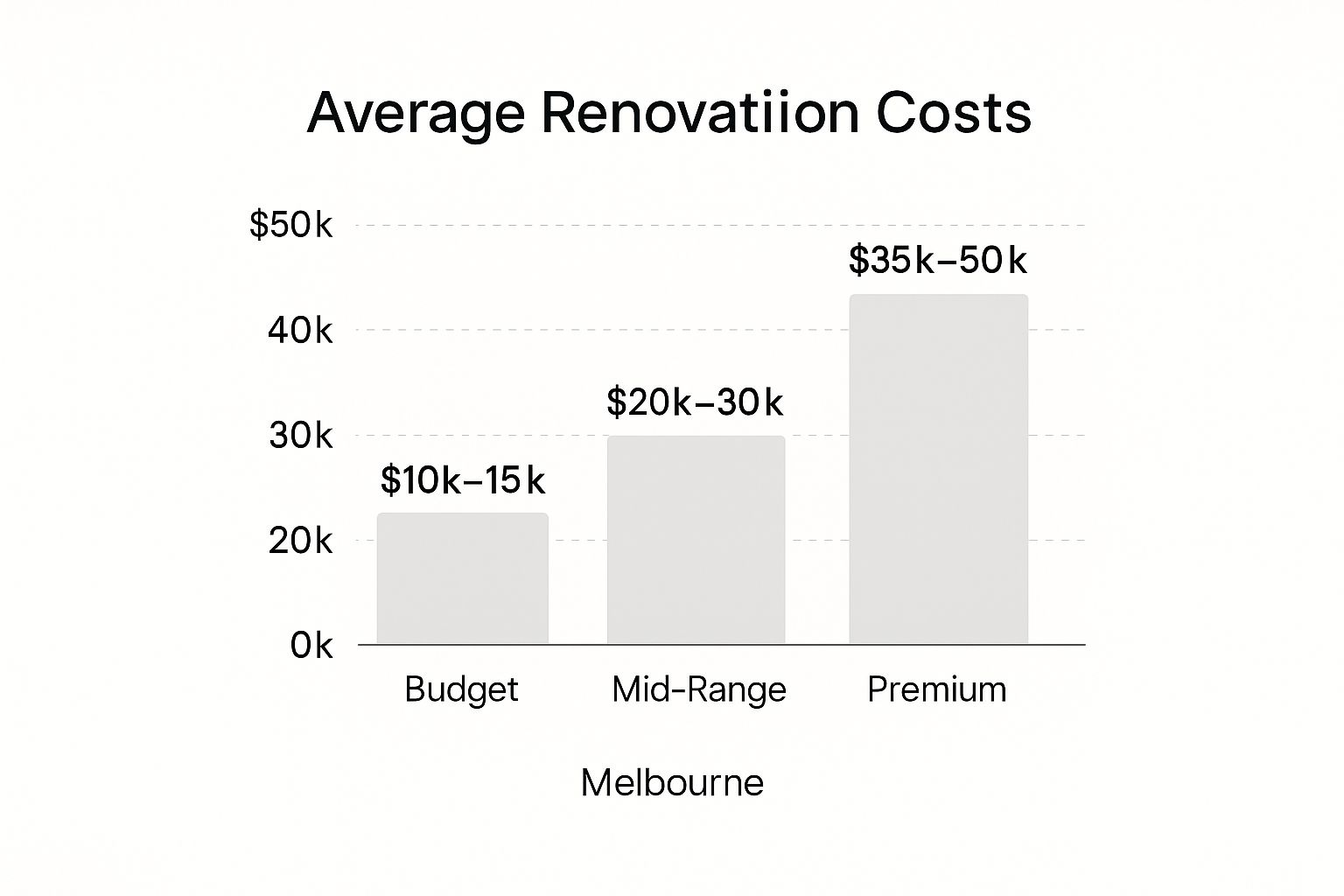
As you can see, the costs climb steadily as you move from a basic budget refresh to a full-blown premium overhaul.
To give you a clearer picture, let's break down what you can generally expect to get within each of these price brackets.
A well-planned budget is the most important tool in your renovation toolkit. It’s not about limiting your dream; it’s about making it happen without financial stress.
Melbourne Kitchen Renovation Cost Tiers at a Glance
So, where does your project fit in? The table below gives a handy summary of the typical price ranges for budget, mid-range, and premium kitchen renovations here in Melbourne. Use this as a guide to see what's achievable at each level.
| Renovation Tier | Estimated Cost Range (AUD) | Typical Inclusions |
|---|---|---|
| Budget | $15,000 – $25,000 | Flat-pack cabinetry, laminate benchtops, basic tiling, a fresh coat of paint, and budget-friendly appliances. |
| Mid-Range | $25,000 – $45,000 | Custom or semi-custom cabinetry, engineered stone benchtops, mid-range appliances, and perhaps some minor layout adjustments. |
| Premium | $45,000+ | Fully custom joinery, natural stone benchtops, high-end appliances, significant layout changes, and even structural work. |
This breakdown should help you align your wishlist with a realistic spending plan, setting you up for a renovation that you'll love without any nasty financial surprises.
Decoding Your Kitchen Renovation Quote Line by Line
Getting a renovation quote can feel like trying to decipher a secret code. You’re handed a long document packed with industry jargon, measurements, and figures that often leaves you with more questions than answers. But getting your head around this document is absolutely crucial, it's the financial roadmap for your entire project.
Think of your total kitchen renovation cost in Melbourne as a whole pie. Every line item on that quote is a slice, some big and some small. We’re going to break down those slices one by one, explaining what each part covers and how it typically affects your budget. By the end of this, you'll be able to read any quote with confidence, knowing exactly where your hard-earned money is going.

The Anatomy of a Renovation Budget
While every kitchen is one-of-a-kind, the cost components are surprisingly consistent across the board. Most mid-range renovations in Melbourne follow a similar budget breakdown, which gives you a great starting point for understanding where the biggest expenses will be. Knowing this helps you figure out where to spend and where you might be able to save.
For instance, cabinetry almost always takes the biggest chunk of the budget. It’s the visual and functional backbone of your kitchen, so it makes sense that it’s the most significant investment. On the flip side, things like tapware and lighting, while important for the final look, represent much smaller slices of the overall cost.
To give you a clearer picture, here’s a typical breakdown of where your money goes in a standard kitchen renovation. You can use this table as a handy guide to see how your quote is likely structured.
Typical Budget Allocation for a Melbourne Kitchen Renovation
| Expense Item | Percentage of Total Budget | Key Considerations |
|---|---|---|
| Cabinetry & Hardware | 30% – 35% | Material choice (e.g., flat-pack vs. custom joinery), finish, and hardware complexity. |
| Benchtops | 15% – 20% | Material is the biggest factor; laminate is budget-friendly, while natural stone is premium. |
| Appliances | 15% – 20% | Brand, features, and energy efficiency ratings all influence the price. |
| Labour & Trades | 20% – 25% | Includes builders, electricians, plumbers, tilers, and painters. This is non-negotiable. |
| Fixtures & Fittings | 5% – 10% | Sinks, tapware, lighting, and splashbacks. Small items that can add up quickly. |
This percentage-based view helps you understand the relative importance of each component and plan your spending more effectively.
Cabinetry and Joinery: The Biggest Slice
As you can see, cabinetry and its installation usually chew up around 30-35% of your total budget. This is the single largest expense in any kitchen reno, and for good reason. Your cabinets dictate the layout, how much storage you have, and the entire look and feel of the space.
The choices you make here will have a massive impact on the final cost.
- Flat-pack Cabinets: Options from places like IKEA or Bunnings are the most affordable. They require assembly and might not be a perfect fit if your kitchen has quirky dimensions.
- Semi-custom Cabinets: This is a great middle ground. You get more flexibility with sizes and finishes than flat-pack, but without the full price tag of custom work.
- Custom Joinery: Built from scratch by a cabinet maker just for your kitchen. It’s the most expensive route but gives you a flawless fit, top-quality materials, and total design freedom.
Seeing how different choices play out in a real project can make it all click. For a great example of how smart material selections can create a stunning yet practical space, have a look at the details of this Reservoir kitchen renovation we recently completed.
Benchtops and Appliances: The Workhorses
Next up, you’ve got benchtops and appliances, with each taking up a hefty 15-20% of the budget. Your benchtop is a huge visual element and gets a lot of daily use, so you need something that looks good and can handle the wear and tear. Laminate is a solid budget-friendly choice, while engineered stone is incredibly popular for its blend of style and durability. Natural stone, like marble or granite, sits at the premium end of the scale.
Appliances are another area where the price can swing wildly. You can get a basic package with an oven, cooktop, and rangehood for under $2,000, but high-end European appliances can easily push past $15,000. It’s all about finding a balance between the features you want and what your budget allows.
Remember, a detailed quote should list every single item separately. If you see vague entries like "Kitchen Supply" or "General Materials," ask for a more specific breakdown. Transparency is key to a successful project.
Labour and Trades: The Essential Skills
Never underestimate the cost of skilled labour. The fees for qualified tradespeople, your builder, plumber, electrician, and tiler, will make up about 20-25% of your project total. This is the money that ensures your kitchen is put together correctly, safely, and meets all Australian standards.
Trying to cut corners on labour is a recipe for disaster. Using licensed and insured professionals is simply non-negotiable. Their expertise is what prevents expensive mistakes down the track, ensures everything is up to code, and delivers a finish that will last for years. A good, transparent quote will always itemise the costs for each trade involved in your Melbourne kitchen renovation.
Key Factors That Drive Your Renovation Price

Ever wondered why two kitchens that seem pretty similar can end up with wildly different price tags? The final number on your quote isn’t just pulled out of thin air. It’s a direct result of several key decisions you’ll make right at the beginning.
Getting a handle on these variables is what puts you in the driver's seat. It allows you to put your money where it matters most to you. Think of it like a set of scales: every choice, from the size of the room to the finish on the cabinet handles, adds weight to one side. The real trick is finding that sweet spot between your dream kitchen and a budget that lets you sleep at night. Let's break down the biggest factors that will shape the total kitchen renovation cost Melbourne homeowners can expect.
The Scale and Scope of Your Project
The most obvious cost driver is simply the size of your kitchen. A bigger space needs more of everything, more cabinetry, more benchtop, more flooring, and more labour to bring it all together. It's just common sense that a small galley kitchen in a Brunswick apartment will cost less to renovate than a sprawling, open-plan kitchen in an Essendon family home.
But it’s not just about square metres. The scope of the work is just as crucial. Are we talking about a simple cosmetic facelift or are you planning on tearing down walls?
- Cosmetic Refresh: This is where you keep the existing layout and all the major services (plumbing and electrical) right where they are. Costs stay down because you’re mainly just updating surfaces like benchtops, cabinet doors, and splashbacks.
- Full Demolition: A complete gut-and-replace job is a bigger undertaking. It means taking everything back to the wall studs and starting from scratch, which bumps up the costs for both labour and rubbish disposal.
- Structural Changes: This is the most expensive path. Moving walls, relocating plumbing, or adding new windows involves structural engineers, more complex trade work, and usually council permits. All of these add significant figures to the budget.
Material and Finish Selections
This is where you'll see the most dramatic swings in price. Your choice of materials is where the whole 'good, better, best' idea really comes to life, and it’s where you have the most control over the final cost.
Just look at the two biggest expenses: cabinetry and benchtops.
The difference between flat-pack and custom joinery isn't just about price; it's about fit, finish, and longevity. One offers immediate savings, while the other provides a tailored, long-term investment in your home's value.
Flat-pack cabinets, like those from IKEA, are easily the most budget-friendly option and can give you a fantastic look for less. The trade-off? They come in standard sizes that might not be a perfect fit for your space and often need a lot more time for assembly. At the other end of the scale, custom joinery is built from the ground up just for your kitchen. You get a perfect fit, premium materials, and endless design choices, but it comes at a premium price.
The same story applies to benchtops. Laminate is a tough and very affordable choice, while engineered stone sits in the mid-range, offering a great balance of style and durability. If you're after a high-end finish, natural stone like marble or granite gives you a one-of-a-kind, luxurious look, but it carries the highest price tag and needs more maintenance.
Appliances and Fixtures
Finally, the appliances and fixtures are the workhorses and the jewellery of your kitchen. The cost here can vary enormously. You could get an entire suite of entry-level appliances for around $3,000. Or, you could opt for a premium package with a high-end European oven, induction cooktop, and integrated dishwasher that could easily top $20,000.
It’s not just the big-ticket items, either. Sinks, taps, and lights might feel like small details, but their costs can add up fast. A basic stainless steel sink and chrome tap are very affordable, but a designer butler's sink with a sleek matte black pull-out tap can cost ten times that.
All these choices add up to the final kitchen renovation cost in Melbourne. With material and labour rates on the rise, every decision counts. In 2025, a project can range anywhere from $15,000 for a simple refresh to over $80,000 for a high-end structural renovation, all based on these very selections. Discover more insights about Melbourne renovation costs and see what’s possible for your home.
Navigating Hidden Costs and Council Requirements

Even the most meticulously planned budget can be thrown off course by unexpected expenses. When you're calculating your kitchen renovation cost in Melbourne, the figures on your initial quotes only tell half the story. Lurking beneath the surface of shiny new benchtops and state-of-the-art appliances are potential costs that can catch even the most organised homeowner by surprise.
These aren't "hidden" costs in the sense that builders are trying to be deceptive. They're often issues that are impossible to foresee until demolition gets underway. Think of it like a routine car service: the mechanic might quote you for an oil change, but if they pop the bonnet and find a badly worn belt, that essential repair gets added to the final bill. Renovations work the same way, especially in Melbourne's wonderfully diverse, and often older, housing stock.
Getting your head around these potential budget-busters beforehand is the best way to stay in control of your finances and keep your stress levels down.
Common Unforeseen Renovation Expenses
Some surprises are more common than others, particularly when you're working on a period home in suburbs like Fitzroy or Hawthorn. The moment you pull back old flooring or open up a wall, you can uncover problems that must be fixed before any new work can start. These aren't optional upgrades; they're critical repairs to ensure your new kitchen is safe, compliant, and built to last.
Here are a few of the usual suspects:
- Asbestos Removal: A common find in homes built before 1990. Asbestos requires specialist removal, which is a significant and completely non-negotiable expense.
- Structural Repairs: This could be anything from replacing rotten timber frames and reinforcing floor joists to dealing with previously hidden termite damage.
- Outdated Wiring or Plumbing: Old electrical circuits or corroded pipes often don't meet current Australian Standards. For everyone's safety, they have to be completely upgraded.
- Water Damage: A slow, hidden leak from an old sink or dishwasher can cause widespread mould and rot in your subfloor, requiring extensive and costly remediation work.
Your contingency fund is arguably the most important line item in your entire budget. A buffer of 10-15% of your total project cost is the industry standard, and it acts as your crucial safety net for these exact situations.
Factoring in Council and Permit Fees
Beyond structural surprises, you've also got to account for the administrative costs. Not every kitchen renovation needs a permit from your local Melbourne council, but many do, especially if you're making major changes. Moving walls, changing the size or location of windows, or altering the building's footprint will almost certainly require a building permit.
The costs involved in this process can include:
- Permit Application Fees: These fees vary between councils but are a standard part of the process.
- Drafting and Architectural Plans: You’ll need a set of professional plans to submit with your application.
- Building Surveyor Inspections: A registered surveyor needs to inspect and sign off on key stages of the construction.
These fees can easily add thousands of dollars to your total kitchen renovation cost in Melbourne before a single hammer is swung. It's vital to talk about permit requirements with your builder early in the planning phase. They can tell you what's needed and build these costs into your overall budget from the start.
This is also where having reliable, licensed professionals on your team is non-negotiable. You can learn more about the importance of qualified Melbourne renovation trades to make sure every part of your project is handled correctly and by the book.
How to Create a Realistic Renovation Budget
A successful kitchen renovation doesn't just happen. It’s built on the foundation of a smart, realistic budget. This isn't about clipping your creative wings; it's about drawing a clear financial roadmap so you can make confident decisions. It’s what ensures the kitchen renovation cost Melbourne homeowners face is manageable and completely transparent from day one.
Think of your budget as the architectural blueprint for your project's finances. Without it, you're essentially building blind, leaving yourself open to costly overruns and a whole lot of unnecessary stress. With a solid plan in your back pocket, you can turn your dream kitchen into an achievable reality.
Start with Solid Research and Multiple Quotes
Your first step is to get out there and gather some real-world numbers. Don't just rely on vague online estimators or guesswork. It's time to reach out to several reputable Melbourne builders and renovation companies to get detailed, itemised quotes for your project.
You should aim for at least three different quotes. Comparing them side-by-side will give you a much clearer picture of the current market rates for materials and labour in your area. It’s also the best way to spot any outliers, quotes that seem way too high or suspiciously low, and helps you find a partner who offers genuine value and transparency.
When you're looking at the quotes, make sure you're comparing apples with apples. Each builder should be quoting on the exact same scope of work, materials, and finishes. Vague quotes are a red flag; you want a detailed breakdown so you can see exactly where every dollar is going.
Distinguish Between Needs and Wants
With a few quotes in hand, it's time for the fun part: aligning your grand vision with your financial reality. This is where you need to be honest with yourself and separate the absolute 'must-haves' from the 'nice-to-haves'. It’s a crucial step that makes prioritising your spending, and making cuts, if needed, so much easier.
Grab a pen and paper and create two distinct lists:
- Must-Haves: These are your non-negotiables. Think of things like a more functional layout, durable benchtops, essential appliances, and safe, compliant plumbing and electricals.
- Nice-to-Haves: This list is for the extras. The beautiful but not essential things, like that high-end designer tap, decorative pendant lighting, or premium cabinet handles.
This simple exercise brings instant clarity. If your initial quotes come back a bit higher than you’d hoped, your 'nice-to-haves' list is the first place to look for strategic savings without gutting the core functionality of your new kitchen.
A well-structured budget is your project's command centre. It allows you to track every dollar, anticipate expenses, and maintain full financial control from the initial design phase to the final handover.
Track Everything and Plan for Surprises
Once your budget is locked in, you need to track it diligently. A simple spreadsheet is your best friend here. Use it to record every single expense, from the builder's deposit right down to the final payment for your tiler. This living document gives you a real-time snapshot of your spending and helps you stay on course.
And here’s the most important tip: every realistic budget must include a contingency fund. This is your safety net, typically 10-15% of your total project cost, set aside for those unforeseeable issues we talked about earlier. It’s what covers unexpected repairs or lets you make a last-minute design change without derailing your entire financial plan.
In Victoria, the average spend on a kitchen renovation hovers around $27,500, which is a significant investment. But with over 60% of renovators experiencing budget blowouts, a healthy contingency fund isn't just a good idea, it's non-negotiable. You can read more about home renovation statistics in Australia to get a better sense of the common financial hurdles homeowners run into.
Planning a Kitchen That Adds Real Value
Working out the cost of a kitchen renovation in Melbourne can feel like a massive task, but it doesn't have to be. Now that you understand the key things that drive the price up or down, from the sheer scope of the job to your choice of materials and appliances, you’re in a much stronger position to create a space that fits both your dreams and your budget.
This guide shows that while average costs are a handy starting point, the final number is really shaped by the decisions you make along the way. A great result always comes down to getting detailed, honest quotes from reputable builders, knowing the difference between what you need and what you want, and setting aside a contingency fund for those inevitable surprises. It's this kind of financial foresight that turns a potentially stressful process into a rewarding one.
Remember, a kitchen renovation is so much more than just another line item on your household expenses.
It’s a strategic investment in your home’s market value, a functional upgrade to your daily life, and an opportunity to create the true heart of your home. The value it adds extends well beyond the final dollar figure on an invoice.
With this knowledge in hand, you're ready to move forward with confidence. The next step is the fun part: gathering inspiration and turning your ideas into a real plan. For some brilliant starting points, check out our guide on the top kitchen renovation ideas in Melbourne to see what’s possible for your home.
Armed with a clear picture of the costs and a vision for your new space, you have everything you need to start the journey. By balancing smart financial planning with thoughtful design, you can build a beautiful, functional kitchen that you and your family will love for years to come, knowing it was an investment well made.
Got Questions? We've Got Answers
Even with all the numbers laid out, you're probably still mulling over a few specific questions about your project. That’s completely normal. Let's tackle some of the most common queries we hear from Melbourne homeowners gearing up for a kitchen renovation.
How Long Will My Kitchen Be Out of Action?
This is the big one, isn't it? The timeline really hinges on the scale of your project. A straightforward cosmetic refresh, think new benchtops and a splashback, might only take 1-2 weeks.
If you're planning a more typical mid-range renovation with new cabinetry, benchtops, and appliances, you'll want to set aside 3 to 6 weeks.
For those bigger projects involving structural work like knocking down walls or moving plumbing, be prepared for a timeline of 6 to 12 weeks, sometimes longer. This accounts for the extra steps like council permits and inspections, which can add time.
Can I Really Save Money with a Flat-Pack Kitchen?
Absolutely. Going with a flat-pack option from a place like IKEA is one of the quickest ways to bring your budget down. You could genuinely save thousands compared to custom or even semi-custom joinery. It's not uncommon for a full set of flat-pack cabinets and appliances to come in under $7,000, whereas custom work for the same kitchen could easily push past $25,000.
Of course, there’s a trade-off. What you save in money, you spend in time and effort putting it all together. You’re also working with standard cabinet sizes, which might not be a perfect glove-fit for every nook and cranny in your kitchen.
A great trick we've seen work beautifully is to pair a budget-friendly flat-pack kitchen with a more luxurious benchtop or a standout splashback. It elevates the whole look, giving you a premium feel without the premium price tag.
Is a Kitchen Renovation a Smart Investment?
Without a doubt. A well-planned and beautifully executed kitchen renovation is one of the best financial decisions you can make for your home. Ask any real estate agent in Melbourne, and they'll tell you that a modern, functional kitchen is at the top of nearly every buyer's wish list. It can seriously boost your property's sale price.
While you might not get back every single dollar you spend, a good mid-range renovation often sees a return on investment of 60-80%. But just as importantly, it completely transforms how you use and enjoy your home every day, and you can't really put a price on that.
Will I Need a Permit for My Kitchen Renovation?
This is a critical question, and getting it wrong can be a costly mistake. The good news is that for simple, like-for-like cosmetic changes, you generally do not need a building permit. This covers things like swapping out benchtops, repainting cabinets, or installing a new sink in the exact same spot.
However, you will need to get a permit from your local council in Melbourne if your plans include:
- Structural Changes: Removing or altering walls, support beams, or posts.
- Altering the Layout: Moving the location of your plumbing pipes or electrical wiring.
- Changing Windows or Doors: Modifying the size or position of any external openings.
The best advice is to chat with your registered builder right at the start. They’ll know exactly what’s required for your project and can handle the whole permit application process for you, making sure everything is done by the book.
Ready to get a clear, transparent quote for your dream kitchen? The team at Smarter Home Renovations has over 20 years of experience delivering beautiful, practical kitchens on time and on budget. Contact us today for an on-site consultation and let's start planning your project.