Discover everything for your modular home extensions Melbourne. Our 2026 guide covers costs, permits, builders & benefits for your property.
If you're feeling the squeeze in your Melbourne home but dread the thought of a traditional, drawn-out renovation, a modular home extension might be the perfect solution. These are precision-built sections of a home, constructed entirely in a factory, away from Melbourne’s unpredictable weather and the usual on-site hold-ups. The finished modules are then delivered to your property and installed, offering a much faster way to get the space you need.
Understanding Modular Home Extensions
When most people think about expanding their home, they picture months of disruption, budgets that seem to spiral out of control, and the constant mess of a construction site. Modular extensions flip that idea on its head by moving almost all the building work into a controlled factory setting. This smart approach is designed to sidestep the most common renovation headaches, offering impressive speed and cost certainty.

Think of it like building with high-tech, precision-engineered building blocks. Each module, whether it's a new bedroom, a larger living area, or a completely self-contained granny flat, is built to incredibly high standards. This factory process doesn't just improve quality. It also dramatically cuts down on material waste compared to a typical build site.
Why Are Modular Builds Gaining Popularity?
Modular construction has quickly gone from a fringe idea to a serious contender in the building industry, especially here in Melbourne where housing pressures and a shortage of on-site trades can slow things down. When traditional building becomes too expensive and takes too long, shifting the work to an off-site factory just makes sense. This isn't just a global trend; it's a practical option for savvy Melbourne homeowners looking for a smarter way to renovate.
For many Melbourne families, a modular extension is the most practical way to adapt their home to changing needs without the immense stress of a conventional renovation. It delivers the space they need, faster and with less disruption to daily life.
This efficient method means you could have a brand-new living room, master suite, or home office in a fraction of the time of a conventional build. The advantages are pretty clear:
- Speed: While your foundations are being prepared on-site, the bulk of the construction is happening in the factory. This parallel process cuts project timelines down significantly.
- Quality: A factory environment allows for meticulous quality control and precision engineering, free from the delays and compromises caused by bad weather.
- Reduced Disruption: The amount of time builders spend on your actual property is minimal. That means less noise, dust, and inconvenience for you, your family, and your neighbours.
Modular vs. Traditional Builds: What's the Difference?
Deciding between a modular extension and a traditional on-site build is one of the biggest choices you'll make for your Melbourne home. While both get you that extra space you need, the process, timeframe, and final cost can be worlds apart. It really comes down to what works best for your property, your family, and your tolerance for renovation chaos.
To really get a feel for why modular is gaining so much traction, it helps to compare it to traditional "stick-built" methods. This is where your extension is built piece by piece on your property, open to the elements and all the delays that come with them. You can learn more from this detailed 2026 guide on traditional home construction to see just how different the process is.

Speed and On-Site Disruption
Without a doubt, the biggest win for modular home extensions in Melbourne is speed.
- Modular: The construction process is incredibly fast. Often up to 50% quicker than a conventional build. This is because the work happens in two places at once. While your foundations and services are being prepared on-site, your extension is being built in a controlled factory environment. This dual-track approach slashes on-site time and almost eliminates weather delays.
- Traditional: Everything happens one step after another, right there in your backyard. This leaves your project exposed to every downpour, supply chain hiccup, and tradie no-show. It’s how a three-month job can easily stretch into a six-month headache.
The real game-changer is how little your life is disrupted. With most of the build happening off-site, the dust, noise, and army of tradespeople are only at your home for a few short weeks, not months on end. You can pretty much carry on as normal.
Budget Certainty and Overall Cost
When it comes to cost, modular construction offers something traditional builds often can't: predictability. Because your extension is prefabricated, a huge chunk of the cost is fixed right from the start, protecting you from unexpected budget blowouts.
National figures suggest a basic modular extension can start from $80,000 to $150,000. In contrast, a standard one-bedroom, site-built extension will often set you back at least $120,000 before the almost-inevitable surprise costs pop up.
Of course, adding an entire new level has its own unique financial considerations. You can dive deeper into that in our article on the cost to add a second storey.
Design Flexibility and Customisation
Think modular means you're stuck with a generic, boxy design? Think again. That's a common myth that couldn't be further from the truth these days.
Modern modular design is incredibly flexible. You can work with architects and designers to create a bespoke extension that perfectly complements your home's existing style, from the cladding and roofline right down to the window frames. The goal is to make it look like it was always there, not just tacked on as an afterthought.
Navigating Melbourne's Planning and Permit Maze
Getting your head around Melbourne's planning and permit system can feel like a full-time job. It’s a maze of council rules and building codes that can easily trip up even the most enthusiastic renovator.
One of the biggest misconceptions I see is the idea that a modular extension somehow bypasses this process. Let’s be clear. Your modular build will need to meet the very same high standards of compliance and safety as any traditional construction project.
The journey always begins with your local council. Melbourne isn't one single entity when it comes to planning. What flies in one suburb might hit a wall of red tape in another.
Key Council Checks You Cannot Skip
Before you let yourself fall in love with a design, you need to do some digging into your property's specific restrictions. These two checks are non-negotiable and will fundamentally shape what's possible.
- Zoning Rules: Your property’s zoning is its basic instruction manual. It dictates whether the land is for residential, commercial, or other use, and therefore whether an extension is even on the cards.
- Heritage Overlays: If your home is in a suburb with a heritage overlay, you’re in for a much more detailed process. These rules protect the neighbourhood’s character, and your extension will need to be designed with sensitivity. Think parts of Brunswick, Hawthorn, or Footscray.
Honestly, navigating these local quirks is half the battle. A builder who has direct, proven experience with your specific council and knows how to work with heritage advisors is worth their weight in gold. They can be the difference between a smooth approval and months of frustrating delays.
Understanding the Regulatory Bodies
In Victoria, a few key players oversee the entire building process. They're there to make sure every project is safe, compliant, and built to stand the test of time.
- Your Local Council: The council is primarily concerned with the planning permit. This looks at how your extension will use the land and impact the look and feel of the neighbourhood.
- The Victorian Building Authority (VBA): The VBA is the state's head regulator for building and plumbing. They issue the building permit, which is all about the technical side of things. It ensures the structure is safe, sound, and meets the National Construction Code. They also make sure your builder is properly registered and insured.
One of the smartest moves you can make is to engage a builder who handles this entire compliance process for you. They’ll prepare and lodge all the necessary paperwork, turning what could be a massive headache into just another seamless step in the project.
If you’d like to dive deeper, our guide on gaining council approval for renovations offers some more detailed insights.
The Modular Build Journey from Start to Finish
So, you’re thinking about a modular extension for your Melbourne home? It’s a smart move. Let’s walk through the entire process, from those first scribbles on a napkin to the final handover. Seeing the journey laid out in clear stages takes the mystery out of it, turning a big project into a series of straightforward steps.
It all kicks off with the design and consultation phase. This is where you sit down with your builder to translate your vision, needs, and budget into a real, workable concept. They'll help you refine your ideas, making sure the new extension works with your lifestyle and feels like a natural part of your existing home. Once that concept feels right, we move into the nitty-gritty of planning.
From Blueprints to Building Permits
This is where the dream starts to take shape on paper. Your initial designs are fleshed out into detailed, construction-ready blueprints. These aren't just for show. They're the critical documents needed for both the factory fabrication and your local council submissions.
This chart breaks down the key milestones for getting all the necessary permissions for your project.

As you can see, getting that building permit involves a few meticulous checks and formal applications. A good builder will handle this entire process, ensuring every box is ticked for full compliance. Once the permits are in hand, the project really gets moving on two fronts at once.
On-Site Prep Meets Off-Site Construction
Here’s where the efficiency of modular building really shines. While your new extension is being built to exacting standards in a controlled factory environment, work also starts at your property. This parallel work saves a huge amount of time.
On-site preparation is absolutely vital and usually includes:
- Foundation Work: Getting the footings or concrete slab ready to support the new module.
- Utility Access: Making sure all the plumbing, electrical, and other services are in place and ready for a quick connection.
- Site Clearance: Clearing the way to make space for the delivery truck, crane, and installation team.
To create a clear work zone and protect your belongings, you may need to move some things into temporary storage. For many Melbourne homeowners, this means choosing furniture movers wisely to ensure everything is handled professionally.
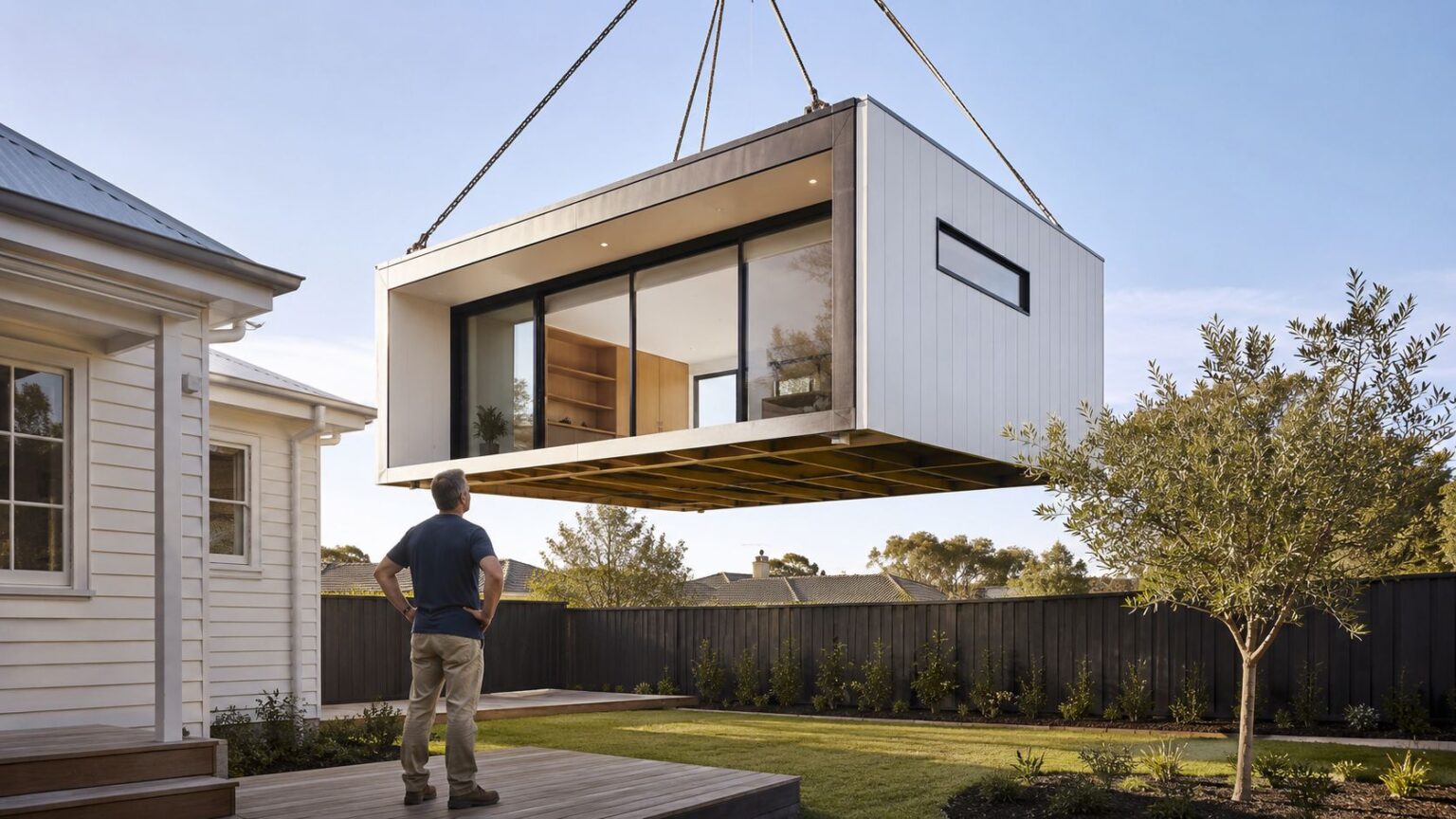
The most exciting part of the whole project is delivery day. A crane carefully lifts your brand-new, nearly finished extension and lowers it perfectly into place. From there, the "stitching" process begins, where trades connect the module to your home, hook up the services, and apply the finishing touches to create a seamless join, both inside and out.
Choosing the Right Modular Builder in Melbourne
Let's be honest, picking the right builder is the single most important decision you'll make for your modular home extension in Melbourne. The success of your entire project rests on finding a team that truly gets it. You need a team with proven experience in both factory-built construction and the hands-on craft of home renovations.
It's a unique skillset. Seamlessly attaching a new, factory-built module to an existing house is an art form. You need a builder who understands the specific logistics, from meticulously planning crane access to flawlessly 'stitching' the extension so it feels like it was always part of your home.
The real mark of a great modular builder is their ability to blend two distinct disciplines: the precision of factory manufacturing and the hands-on craft of residential renovation. They must be experts in both worlds.
Essential Questions for Potential Builders
When you're vetting companies, your questions need to cut straight to their specific qualifications and process. A quality builder will welcome this and have clear, confident answers ready.
Here are the essentials to get you started:
- Licensing and Registration: First things first, are you a Registered Building Practitioner with the VBA? This is a non-negotiable check for any legitimate builder in Victoria.
- Modular Experience: Can I see a portfolio of your finished modular home extensions in Melbourne? You want to see projects similar to yours in both scope and style.
- Site Visits: Is it possible to speak with past clients or even visit a completed project? There’s nothing more reassuring than hearing directly from a happy client.
- Transparent Pricing: How do you structure your quotes? Ask for a detailed, itemised breakdown so you can be confident there are no hidden costs lurking.
- Communication: What’s your process for keeping clients in the loop during the build? A clear communication plan is the best way to prevent stress and misunderstandings down the track.
Finding a reputable home extension builder with this specialised expertise gives you the confidence that your project will be done right, on time, and on budget.
Common Questions About Modular Extensions
When you're looking at a modular extension for your Melbourne home, it's natural to have a few questions. We get asked these all the time, so let's run through some of the most common ones to help you plan.
Can I Add a Modular Extension to My Period Home?
Absolutely, and the results can be stunning. This is a specialist job, though. You'll need a builder who has real-world experience with Melbourne's heritage overlays and knows how to work with local council advisors.
The key is getting the design right. You can either create a seamless addition that perfectly mimics your home’s original character. Or you can go for a deliberate, stylish contrast between the old and new. With the right team, it's a brilliant way to bring modern living to a classic home without losing any of its charm.
How Disruptive Is the On-site Installation Process?
This is where modular really shines. It's significantly less disruptive than a traditional build, and by a long shot.
Most of the noisy, messy, and time-consuming work happens in a factory, not in your backyard. The on-site activity is condensed into a much shorter timeframe, mainly covering the initial foundation prep and the actual delivery day. The final "stitching" and interior finishing is much faster and quieter than living next to a full-blown construction site for months on end.
A huge advantage of modular home extensions in Melbourne is the minimal disruption. The process is designed so you can get on with your life while the heavy lifting happens off-site, cutting months of potential chaos down to just a few crucial weeks.
Do Modular Extensions Have Good Resale Value?
Yes, they do. A high-quality modular extension adds value to your property just like any other well-built, well-designed extension. As long as it's built by a reputable company to Australian Standards and integrated properly with the existing house, buyers and valuers see it as a permanent, valuable improvement.
The old stigma around prefabricated buildings is long gone. Today, modular is widely seen as a premium, efficient way to build. A beautiful, functional extension is always going to be a major asset on the property market, no matter how it was constructed.
What Happens If I Have Difficult Site Access?
This is one of the very first things you need to bring up with any potential builder. It's a critical point for any modular project.
Don't assume a tight inner-city block makes it impossible. Most modular companies are logistics experts and will perform a thorough site inspection to figure out access for cranes and delivery trucks. Experienced builders often have very creative solutions for getting around the tricky constraints of older Melbourne properties, sometimes using smaller modules or panellised systems to get the job done.
Planning a renovation can be complex, but it doesn't have to be. For expert advice and a seamless build from start to finish, get in touch with the team at Smarter Home Renovations. Find out how we can help you create the space you need by visiting smarterhomerenovations.com.au/contact.
Do You Need A Quote
No matter what project you need to complete, our team of professionals at Smarter Home Renovations has the right solution for you.
To find out more about our quality home, kitchen, bathroom and laundry renovations in Melbourne, call Tony on 0418 802 802 today. Or go to our contact page and complete the form its that easy.
Some Handy Links