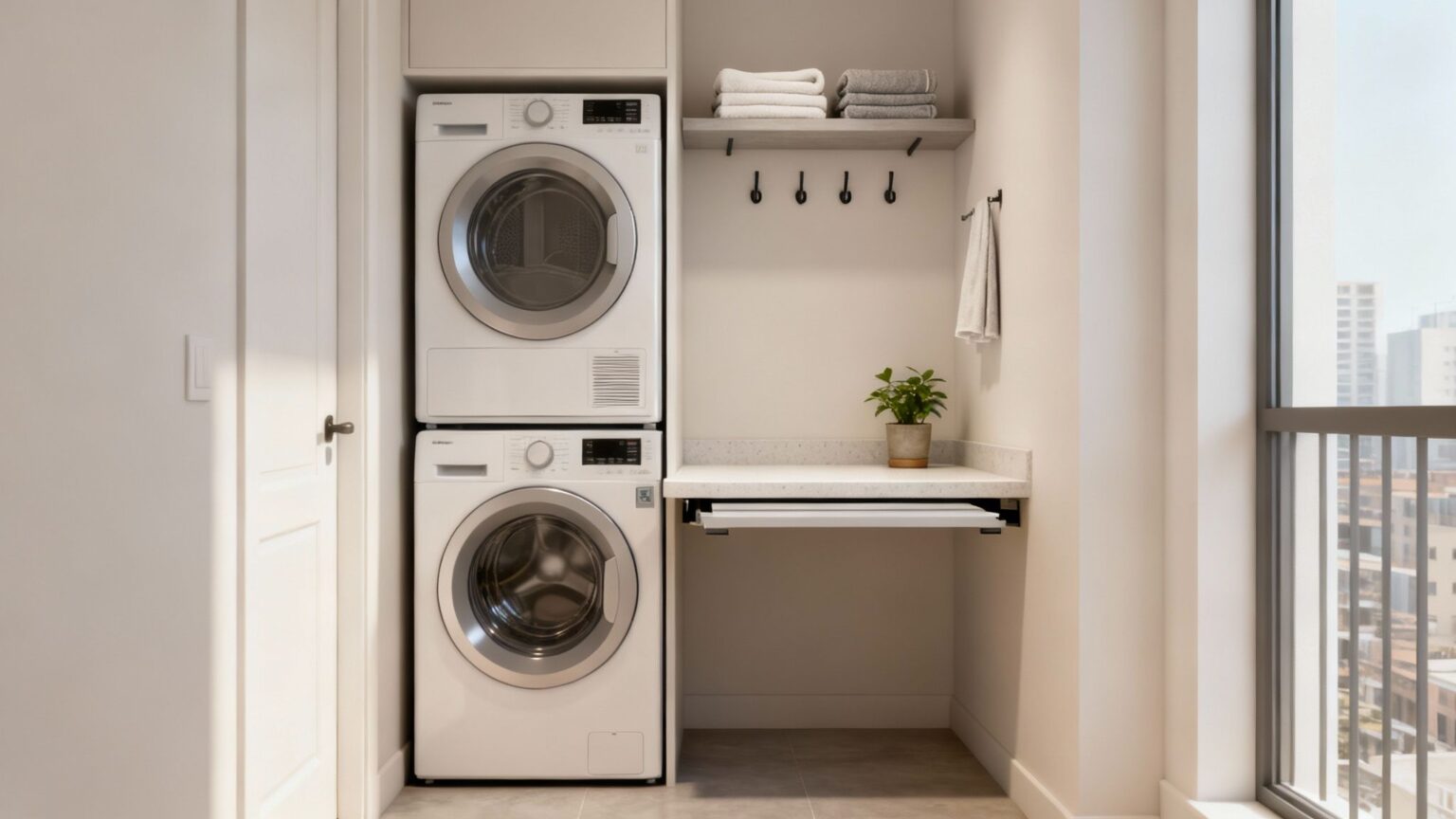
Discover laundry designs that fit tight spaces with clever layouts, storage hacks, and compact appliances to maximise function and style.
Staring at a tiny laundry space can feel pretty restrictive. But I've seen time and time again how smart laundry designs for small spaces can turn a cramped corner into a surprisingly efficient zone. The key is to think vertically and choose appliances and storage that work harder for you. It's all about transforming those forgotten nooks into stylish, functional hubs.
Unlocking the Potential of Your Compact Laundry

Limited square footage is a common challenge in modern Melbourne apartments and homes. But a small laundry doesn't mean you have to sacrifice function or style. Instead of seeing a tiny room, a closet, or an alcove as a limitation, we see it as an opportunity for intelligent, purposeful design. The real goal is to move beyond the frustration of clutter and create a space that genuinely simplifies your daily routine.
This guide is packed with real-world, actionable advice for making the most of your compact area. We’ll explore practical strategies that tackle the core issues of small laundries head-on.
Key Focus Areas for Small Laundry Design
- Clever Layouts: We'll show you how to create an effortless workflow, whether you have a narrow closet or just a small section of a bathroom to work with.
- Multi-Functional Storage: You'll learn techniques to eliminate clutter with solutions that hide mess and keep essentials beautifully organised.
- Appliance Selection: We'll dive into how to choose compact, efficient machines that free up valuable floor and benchtop space.
By focusing on these elements, you can create a laundry that feels organised, spacious, and perfectly suited to your home. It’s not about finding more space; it’s about making your existing space work smarter.
Many of these principles apply to maximising potential throughout your home. For a broader look at making the most of limited square footage, these smart small space designs offer some fantastic insights that can also inspire your laundry project.
From picking the right layout to implementing innovative storage, every choice contributes to a more functional and enjoyable home. Let's walk you through each step, giving you the confidence and knowledge to create a compact laundry you’ll actually love using.
Finding the Right Layout for Maximum Efficiency
The layout is the absolute foundation of a great small laundry design. Forget about cookie-cutter solutions; the trick is to pick a blueprint that genuinely works with the footprint you've got. When every centimetre counts, a smart layout is the difference between a frustrating, cramped chore space and a laundry routine that’s actually effortless.
It’s all about making strategic choices to turn a tricky area into a seriously functional one. Let’s walk through three of the most effective layouts we use for compact laundries.
The Vertical Stacked Layout
The stacked layout is the undisputed champion when you’re dealing with a narrow cupboard or a tight vertical spot. By putting the dryer directly on top of a front-loading washing machine, you’re using the room's height and freeing up precious floor space.
This is the perfect setup for those European-style laundries you see tucked away behind bifold doors in modern apartments.
- Best For: Tall, narrow closets, small apartment nooks, or anywhere floor area is at an absolute minimum.
- Key Benefit: It has the smallest physical footprint of any layout, often needing a space as little as 70-80cm wide.
- Consideration: You'll need front-loading machines for this to work, and it can make adding a full-depth benchtop directly over the appliances a bit tricky.
The Galley Style Layout
If you’ve got a narrow passageway, a section of a hallway, or a slim room to work with, the galley layout is a fantastic option. This design lines your washer and dryer up side-by-side, usually under one continuous benchtop. This creates a brilliant, streamlined workspace for sorting, treating stains, and folding clothes, all in one organised line.
This approach actually borrows a lot from efficient kitchen design. In fact, many of the same space-saving strategies apply, which is something we cover in our guide on layout ideas for small kitchens. The long, unbroken benchtop is the real hero here, giving you an incredibly useful surface that stacked layouts just can't offer.
The Hidden Alcove Layout
The hidden alcove is all about integrating your laundry into another room, like a kitchen, bathroom, or even a large pantry. Here, the appliances are completely concealed behind cabinetry that matches the rest of the room, creating a seamless, cohesive look. This is a brilliant solution when you don't have a dedicated laundry room at all.
A hidden alcove is the ultimate space-saving trick. It keeps your laundry functional but completely out of sight, preserving the primary function and aesthetic of the room it’s in.
To help you decide, here’s a quick comparison of how these three layouts stack up against each other.
Small Laundry Layout Comparison
Stacked
- Best For: Extremely tight vertical spaces, cupboards, Euro laundries
- Typical Dimensions: 70–80cm wide, 70–80cm deep
- Pros: Smallest footprint, uses vertical space efficiently
- Cons: Requires front-loaders, no bench space over appliances
Galley Layout
- Best For: Narrow rooms, hallways, pass-through areas
- Typical Dimensions: 130–150cm wide, 70cm deep
- Pros: Generous benchtop for sorting and folding, streamlined workflow
- Cons: Requires more horizontal wall space than a stacked layout
Alcove Layout
- Best For: Homes without a dedicated laundry room, kitchens, bathrooms
- Typical Dimensions: Varies greatly based on cabinetry
- Pros: Completely hidden, maintains the room’s aesthetic
- Cons: Can be more complex and costly to build custom cabinetry
Choosing the right layout really comes down to the space you have and how you need it to function.
Picking the right appliances is crucial for these compact layouts to work. It’s interesting to see that the Australian laundry appliance market, valued at AUD $1.64 billion for 2025, is growing fast, largely driven by demand for these exact kinds of space-efficient models. This trend really highlights how critical the right machine is for making these small designs click. You can read more about these laundry appliance market trends to get a feel for the latest innovations.
Each of these layouts offers its own clear benefits. By properly assessing your available space and thinking about your daily routine, you can lock in the perfect configuration to make your small laundry both practical and a pleasure to use.
Choosing Smart Appliances for Your Compact Laundry
When you're working with a small laundry, your choice of appliances is more than just a practical decision, it's the foundation of the entire layout. The right washer and dryer can turn a cramped closet into an efficient workhorse. The wrong ones? They can make the space feel completely unusable. Getting this part right is absolutely crucial.
The Front-Loader Advantage
For almost any compact laundry design, front-loading washing machines are a non-negotiable. Their biggest superpower is creating usable space directly on top. This simple choice unlocks the potential for a continuous benchtop, giving you a proper spot for sorting, folding, and treating stains.
Suddenly, you’ve added valuable workspace to your home. To make sure that surface is at a comfortable and practical height, it’s worth checking out our guide on the correct standard benchtop height.
Finding the Right Fit for Your Space
If you're really tight on room, a washer-dryer combo unit is a brilliant solution. These all-in-one machines are perfect for those little European-style laundries tucked away in a cupboard. They free up just enough space to squeeze in a small sink or an extra storage cabinet. A quick heads-up: their drying capacity is usually about half their washing capacity, so they’re best suited to smaller households.
Another great option to look out for is a slimline model. Lots of top brands now offer washers and dryers with a reduced depth. This means they can slide into shallower cavities without sticking out awkwardly, which is a total game-changer in a narrow hallway or a tight alcove.
This decision tree can help you visualise which layout and appliance configuration might work best based on your available space.

As the flowchart shows, where your laundry is located, whether it's a closet, hallway, or part of a bathroom, will point you towards the most practical layout, guiding you to either a stacked or side-by-side setup.
Beyond Just Size and Shape
Once you've nailed down the dimensions, there are a couple of other critical things to think about.
- Noise and Vibration: If your laundry is anywhere near your living areas or bedrooms, check for models with low decibel (dB) ratings and good anti-vibration tech. A quiet machine makes a massive difference to the peace and quiet of your home.
- Energy and Water Efficiency: High WELS and Energy Star ratings aren't just about being eco-friendly. They're a sign of a modern, well-engineered appliance that will save you money on bills over its lifespan. And those savings really do add up.
At the end of the day, you're looking for appliances that slot seamlessly into your compact space, making it work better without overwhelming it. Prioritise a front-loader for that precious bench space, consider a combo unit if you’re really squeezed, and don’t forget about noise levels. That’s how you set up a small laundry for maximum efficiency.
Getting Clever with Storage and Organisation

In a small laundry, clutter is public enemy number one. When every centimetre counts, smart storage isn't just a bonus, it's the key to creating a space that’s functional and actually pleasant to be in. We need to think beyond a single shelf above the washer and get creative with solutions that keep everything organised and tucked away.
The best laundry storage comes from thinking vertically and making use of otherwise dead space. It’s all about looking past the obvious and building storage right into the fabric of the room.
Make the Most of Vertical Space
The quickest way to find more storage in a tight laundry is to look up. Floor-to-ceiling cabinetry can completely change the game, giving you a sleek, built-in look while hiding everything from detergent bottles to the ironing board. This approach also draws your eye upwards, which cleverly makes the room feel taller and more open.
If a full wall of joinery isn't on the cards, a mix of open shelving and closed cupboards is a great compromise. Use the open shelves for things you grab all the time, just pop them in nice containers, like glass jars for washing pods or woven baskets for cloths. This keeps the space from feeling too boxed in while still having everyday items right where you need them.
One of the biggest mistakes we see is people leaving the wall space between the benchtop and upper cabinets completely bare. That’s prime real estate! It’s perfect for a hanging rail for shirts, a magnetic strip for bits and bobs, or some shallow shelves for stain removers.
Integrated and Hidden Storage Solutions
Often, the smartest storage solutions in a small laundry are the ones you can't even see until you need them. These clever, built-in features are the secret to keeping that clean, streamlined look without giving up an ounce of functionality. By building storage directly into your cabinetry, you create a space that works harder without looking crowded.
Here are a few game-changing ideas our team at Smarter Home Renovations loves to include in our designs:
- Pull-Out Drying Racks: Forget that clunky clothes horse that’s always in the way. A pull-out drying rack can be hidden inside a tall cabinet or a deep drawer, ready to go when you have delicates to dry.
- Fold-Down Ironing Boards: A wall-mounted or drawer-integrated ironing board is a true space-saver. It folds away neatly, solving the age-old problem of where to stash one of the most awkward items in the house.
- Tilt-Out Hampers: This is one of our most popular requests. Building a hidden hamper directly into your base cabinetry keeps dirty clothes sorted and completely out of sight. No more laundry baskets tripping you up.
- Slim Rolling Carts: That little gap between the washer and the wall? It's not wasted space. A slim rolling cart fits perfectly in these nooks, giving you an ideal spot to store bottles of detergent and softener.
By focusing on these kinds of solutions, you can be sure that every part of your small laundry is pulling its weight. The result is a highly organised, efficient space that feels much bigger than it actually is.
Selecting Finishes That Enhance and Endure
This is where your laundry’s personality really comes to life. The finishes you choose are where function and style truly meet. Sure, they need to look good, but in a small laundry, every surface has to be a hardworking hero, ready to stand up to moisture, heat, and the general chaos of daily life.
Let's move beyond just a utilitarian space. This is your chance to pick materials that feel intentional, beautiful, and built to last. In a high-humidity environment like a laundry, skimping on material quality is a recipe for warped cabinets and stained benchtops down the track.

Durable and Stylish Benchtops
Your benchtop is probably the single most abused surface in the laundry. It needs to be tough enough to handle spills from detergents, the weight of heavy baskets, and constant wiping.
- Engineered Stone: This is a fantastic choice. It’s non-porous, meaning it’s highly resistant to water and stains. Plus, it delivers a premium, seamless look and incredible durability that’s hard to beat.
- Quality Laminate: Don't dismiss modern laminates. They've come an incredibly long way from the laminates of the past, offering a massive range of colours and finishes, including very realistic stone and timber looks, at a much more budget-friendly price point.
The principles for choosing surfaces in a laundry aren't all that different from other wet areas. Just like selecting the best flooring for small bathrooms, including stylish and waterproof options, you're looking for that perfect balance of moisture resistance, durability, and style.
Illuminating Your Space
Lighting is one of the most powerful tools you have, especially in laundry designs for small spaces. Get the lighting right, and you can make a compact room feel significantly bigger, brighter, and far more pleasant to work in.
A common mistake we see is people relying on a single, lonely overhead light. This almost always creates shadows right where you need to see. A layered approach that combines general ambient light with specific task lighting is always more effective.
A real game-changer is installing under-cabinet LED strips. This simple addition floods your entire benchtop with light, making tasks like sorting clothes or measuring out detergent so much easier and safer. No more squinting in the shadows.
Ensuring Fresh Air with Proper Ventilation
Finally, let's talk about something that's absolutely non-negotiable: ventilation. A powerful, efficient exhaust fan is your number one defence against mould, mildew, and that lingering stale, damp air smell.
It does more than just clear the air; it actively protects your investment, your cabinetry, your paintwork, and your own health, by pulling moisture-laden air right out of the room. A quiet, powerful model is a small cost upfront that pays massive dividends in maintaining the quality and health of your brand-new laundry for years to come.
Nailing Down Your Laundry Renovation Plan and Budget
Embarking on any renovation, even for a compact laundry room, absolutely needs a clear plan and a realistic budget from the get-go. Here in Melbourne, the costs can swing wildly. A simple cosmetic refresh is one thing, but a complete overhaul that involves moving plumbing or electrical points is a whole different ball game. Getting your head around these numbers early on takes the guesswork out of the process.
For a straightforward facelift think a fresh coat of paint, new cabinet handles, and maybe a stylish light fitting. It can often be pulled off for under $2,000. But if you're looking at a full-gut renovation with custom cabinetry, a new benchtop, tiling, and getting the pros in, you're typically looking at a range of $5,000 to $15,000. For high-end finishes or major structural changes, that number can climb even higher.
Where to Invest and Where to Save
Knowing where your money is best spent is the key to getting real value from your renovation.
- Invest: Don't even think about skimping on quality waterproofing, licensed plumbing, and electrical work. These are completely non-negotiable for safety and compliance. It’s also smart to invest in good quality, moisture-resistant cabinetry and benchtops that can handle the humidity and daily wear of a laundry for years to come.
- Save: You can find seriously stylish and affordable tiles, tapware, and lighting if you shop around. And if you're comfortable getting on the tools, tackling jobs like painting or assembling flat-pack cabinets yourself can make a real dent in your labour costs.
For a deeper dive into making every dollar work harder, check out our guide to laundry renovations on a budget.
It's easy to get caught up in the home renovation side of things, but it’s fascinating how the principles of smart, small-space design are also a big deal in the commercial world. A well-designed small laundromat can be surprisingly profitable, which really drives home the value of using space wisely.
While your laundry at home isn’t a business, the same logic applies. For instance, data for small Aussie laundromats shows that with a well-planned, compact setup, total expenses can be kept to an average of 70% of turnover, making them a solid venture. It just goes to show how thoughtful laundry designs for small spaces deliver real returns, whether you're washing for a family or for customers.
Finally, always remember to check in on local Melbourne regulations. Simple updates rarely need a permit, but anything involving moving walls or shifting plumbing will likely mean you need to have a chat with your local council or strata management first.
Your Small Laundry Design Questions, Answered
To wrap things up, let's tackle some of the most common questions we get from homeowners when they're planning a laundry for a small space. These are the practical, real-world queries that come up time and time again. Getting these answers right can help you navigate your project with confidence and sidestep some common pitfalls.
How Much Space Do You Really Need for a Functional Laundry?
You’d be surprised how little room you actually need for a fully functional laundry. We’ve fitted perfectly practical laundries into some very tight spots.
For a vertically stacked washer and dryer, you can get away with a closet as narrow as 70-80cm. If you're dreaming of a side-by-side setup under a continuous benchtop, which is great for folding, you'll generally need about 130-140cm in width. It all comes down to precise measurements and selecting the right compact appliances for the job.
Are All-in-One Washer-Dryers a Good Choice for Small Spaces?
These combination units can be absolute lifesavers, especially in apartments or European-style laundries where every single centimetre is precious. They neatly pack two essential functions into the footprint of a single appliance, which is a massive win for space efficiency.
Just be aware of the trade-off. Their drying capacity is usually about half their washing capacity, and a full wash-and-dry cycle takes quite a bit longer than using separate machines. They're a fantastic solution for smaller households or anyone with lighter laundry loads.
Will I Need a Permit for a Laundry Renovation in Melbourne?
This is a big one. For simple cosmetic updates and swapping out old fixtures for new ones in the same spot, you generally won't need a permit.
However, the moment your project involves moving walls, altering plumbing lines, or making any significant electrical changes, you'll almost certainly need to chat with your local council. Honestly, it’s always a smart move to check first, no matter the scope. That way, you can be sure your project complies with all the local regulations right from the start.
Ready to finally transform that cramped laundry into a space that's both stylish and incredibly efficient? The team at Smarter Home Renovations has the expertise to bring your vision to life. Contact Tony for a consultation and let's start planning your perfect laundry renovation today.